Criteria
IELTS writing band score checkers: what they can and cannot tell you
A band score checker can estimate your four IELTS writing criteria but not predict your test score. What it can judge, what it can't, and how to pick one.
11 min read
The official IELTS Writing band descriptors, quoted from the May 2023 public version, with what each line looks like inside a real essay.
The IELTS Writing band descriptors are published in full, and they say exactly what separates one band from the next — but they say it in a register that makes the difference hard to see. This page quotes the official wording for each criterion from band 5 to band 8, and then shows what that wording looks like as an actual sentence in an actual essay.
Everything quoted below comes from the public band descriptors updated in May 2023. If a page tells you band 7 Task Response requires a clear position "throughout the response", it is quoting a version that has been superseded.

IELTS publishes three sets: one for Task 1 Academic, one for Task 1 General Training and one for Task 2. Each scores four criteria.
There is a public version of the Writing band descriptors, and IELTS publishes it as a PDF. There is one set for Task 1 Academic, one for Task 1 General Training, and one for Task 2. Alongside them IELTS publishes a separate document of key assessment criteria, which explains the reasoning the descriptors compress.
Three things follow that most candidates get wrong.
First, a band is a judgement about the whole descriptor, not a checklist. The wording for each band is a paragraph, and an examiner decides which paragraph best fits the script as a whole. You do not collect points by satisfying individual clauses.
Second, the descriptors describe the answer, not the effort. There is no clause anywhere about how hard a structure was to attempt, and no credit for reaching for something and missing.
Third, some rules sit outside the band scale entirely. The descriptors state that "Responses of 20 words or fewer are rated at Band 1." And the key assessment criteria document notes that a response may be penalised if it is "partly or wholly plagiarised", or if it is "not written as full, connected text (e.g. using bullet points… or note form…)". Those are conditions on the answer, not criteria you are scored against.
What the public documents do not tell you is anything about the materials examiners are trained on. IELTS publishes a public version; that is the accurate statement, and any page claiming to know how closely it matches internal material is guessing.
Both tasks are marked on four criteria. Three of them are the same across Task 1 and Task 2: Coherence and Cohesion, Lexical Resource, and Grammatical Range and Accuracy. The fourth is where the two tasks part company.
Task 2 is marked on Task Response. Task 1 is marked on Task Achievement. These are different criteria with different wording, and the confusion is so widespread that you can use it to judge a source: a page that talks about "Task Response" in a Task 1 article is not working from the documents.
Task Achievement, Task 1 Academic:
Band 6 — "Key features which are selected are covered and adequately highlighted. A relevant overview is attempted."
Band 7 — "The response covers the requirements of the task. The content is relevant and accurate – there may be a few omissions or lapses. It presents a clear overview, the data are appropriately categorised, and main trends or differences are identified."
Band 8 — "The response covers all the requirements of the task appropriately, relevantly and sufficiently."
General Training Task 1 carries clauses that Academic does not, because a letter has a purpose and a tone:
Band 6 — "The purpose is generally clear. There may be minor inconsistencies in tone."
Band 7 — "It presents a clear purpose. The tone is consistent and appropriate to the task. Any lapses are minimal."
Band 8 — "All bullet points are clearly presented, and appropriately illustrated or extended."
How the four combine is also published: "The criteria are weighted equally and the score on the task is the average." Note the wording. It is weighted equally and averaged — not four blocks of a percentage, which is a paraphrase that has spread widely and is not what the documents say.
The two tasks are then combined for the Writing score, and here IELTS states only that "Task 2 contributes twice as much as Task 1 to the Writing score." That is the whole of the official claim. Exact fractions and rounding formulas circulate, but they are reconstructions.
Band 5 — "The main parts of the prompt are incompletely addressed. The format may be inappropriate."
Band 6 — "The main parts of the prompt are addressed (though some may be more fully covered than others). A position is presented that is directly relevant to the prompt, although the conclusions drawn may be unclear, unjustified or repetitive."
Band 7 — "The main parts of the prompt are appropriately addressed. A clear and developed position is presented. Main ideas are extended and supported but there may be a tendency to over-generalise or there may be a lack of focus and precision in supporting ideas/material."
Band 8 — "The prompt is appropriately and sufficiently addressed. A clear and well-developed position is presented in response to the question/s."
What this looks like in an essay. At band 5, a two-part question gets one part answered and the other mentioned. At band 6, both parts are there but one gets a paragraph and the other gets a sentence, and the conclusion says something the body did not earn. At band 7, both parts get real coverage, the position is stated and then built on, and the weakness is generalisation — the supporting material is true of everything rather than of this argument. At band 8, the coverage is not just appropriate but sufficient: nothing important is left thin.
The word that decides the band. Between 6 and 7 it is developed. Band 6 asks only that a position be presented; band 7 asks for a position that is "clear and developed". A candidate who states a view in the introduction, argues around it for three paragraphs and restates it at the end has presented a position without developing one.

Each criterion is its own staircase. One word usually marks the step from band 6 to band 7.
Between 7 and 8 the word is sufficiently. Band 7 says the prompt is "appropriately addressed"; band 8 says "appropriately and sufficiently addressed". Appropriate means you answered the right question. Sufficient means you answered enough of it. That is why band 8 scripts are rarely longer than band 7 scripts — the gain is in what each paragraph finishes, not in how many there are.
Note also what band 7 does not say. It does not require a position held "throughout the response". That phrasing belongs to the earlier version of the descriptors and is still quoted on a great many pages.
Band 5 — "Organisation is evident but is not wholly logical and there may be a lack of overall progression."
Band 6 — "Cohesive devices are used to some good effect but cohesion within and/or between sentences may be faulty or mechanical due to misuse, overuse or omission."
Band 7 — "Information and ideas are logically organised, and there is a clear progression throughout the response. A range of cohesive devices including reference and substitution is used flexibly but with some inaccuracies or some over/under use."
Band 8 — "The message can be followed with ease. Information and ideas are logically sequenced, and cohesion is well managed."
What this looks like in an essay. Band 5 has paragraphs, but reordering them would cost nothing. Band 6 is the Firstly / Secondly / Moreover script: the devices are present, and the descriptor names the exact failure — "misuse, overuse or omission". Band 7 adds two things the lower bands lack, and the descriptor names them explicitly: reference (pronouns and phrases that point back — "this pattern", "the same argument") and substitution (replacing a repeated item rather than restating it). Band 8 is the one described from the reader's side rather than the writer's: "The message can be followed with ease."
The word that decides the band. Between 6 and 7, it is reference. It is the only place in the four criteria where the descriptor names a specific linguistic device you can go and practise. If your cohesion is carried entirely by connectives at the start of sentences, you are describing band 6 wording, however many connectives you know.
Between 7 and 8, the shift is from organised to sequenced. Organised means the ideas are in groups. Sequenced means each one follows from the last. A script can be perfectly organised and still make the reader assemble the argument themselves; that is the gap band 8 closes.
Band 5 — "The resource is limited but minimally adequate for the task."
Band 6 — "The resource is generally adequate and appropriate for the task. The meaning is generally clear in spite of a rather restricted range or a lack of precision in word choice."
Band 7 — "The resource is sufficient to allow some flexibility and precision. There is some ability to use less common and/or idiomatic items. An awareness of style and collocation is evident, though inappropriacies occur."
Band 8 — "A wide resource is fluently and flexibly used to convey precise meanings."
What this looks like in an essay. Band 5 gets the meaning across with a small stock of words and visible strain. Band 6 is clear but blunt — "important", "a lot of", "good for the environment" — and imprecise where precision was available. Band 7 reaches past the common word and mostly lands it, with the descriptor conceding that "inappropriacies occur". Band 8 is not a bigger vocabulary used more often; it is a wide resource used to convey precise meanings, which is a claim about accuracy, not about difficulty.
The word that decides the band. Between 6 and 7 it is precision, and the criterion names its two components: style and collocation. Knowing a rare word is not the qualification. Knowing which words it sits with is.
There is one detail here that reverses the common advice. Idiomatic language is named at band 7, not at band 8. Band 7 says "less common and/or idiomatic items"; the band 8 wording drops the word entirely and asks for a wide resource used precisely. Reaching for idiom in the belief that it signals a high band is, on the descriptors' own terms, aiming at the band below.
Band 5 — "The range of structures is limited and rather repetitive."
Band 6 — "A mix of simple and complex sentence forms is used but flexibility is limited. Examples of more complex structures are not marked by the same level of accuracy as in simple structures."
Band 7 — "A variety of complex structures is used with some flexibility and accuracy. Grammar and punctuation are generally well controlled, and error-free sentences are frequent."
Band 8 — "A wide range of structures is flexibly and accurately used. The majority of sentences are error-free."
What this looks like in an essay. Band 5 repeats a small number of patterns. Band 6 contains the most familiar trap in the whole scale, and the descriptor states it outright: the complex sentences are less accurate than the simple ones. The writer is attempting range and paying for it in accuracy, and the two cancel.
Band 7 asks for variety with control, and sets its accuracy bar as frequent error-free sentences. Band 8 raises that single word to the majority. This is the most precisely quantified line in the descriptors, and it is worth reading carefully: even at band 8, sentences containing errors are expected. What changes is the proportion.
The word that decides the band. Between 6 and 7 it is control — the complex structures have to be as accurate as the simple ones, not merely present. Between 7 and 8 it is the move from frequent to majority, which is the only place the descriptors come close to a countable threshold.
The practical consequence runs against instinct. Writing short, safe sentences protects accuracy and forfeits range, and the band 7 wording requires both. A script of fifteen short correct sentences does not meet "a variety of complex structures", however clean it is.
Read the four criteria side by side and the same qualifiers keep reappearing at the same heights. The descriptors are built on two ladders, and once you can hear them, the wording stops being vague.
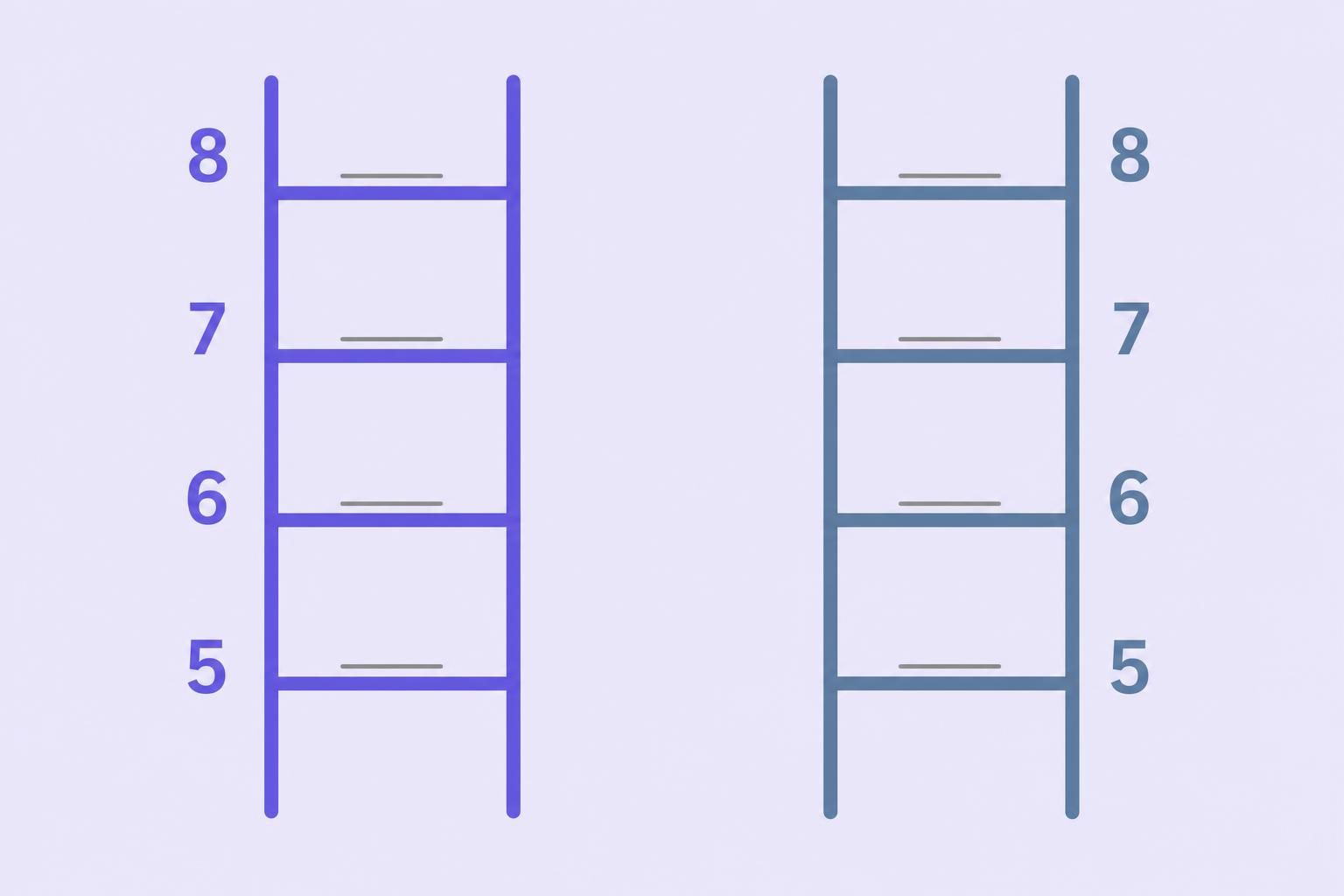
The same qualifiers recur at the same heights across all four criteria — one ladder for adequacy, one for resource.
The adequacy ladder — how well the task itself is met:
| Band | Qualifier used in the descriptors |
|---|---|
| 5 | incompletely, minimally adequate |
| 6 | attempted, adequately, generally adequate |
| 7 | appropriately, sufficient |
| 8 | sufficiently, well-developed |
The resource ladder — how much language is available and how freely it moves:
| Band | Qualifier used in the descriptors |
|---|---|
| 5 | limited, repetitive |
| 6 | generally adequate, restricted |
| 7 | sufficient, some flexibility |
| 8 | wide, fluently and flexibly |
Two observations that repay attention. Attempted is a band 6 word — it appears in Task Achievement at band 6 ("A relevant overview is attempted") and never above it, which is a precise way of saying that trying is scored below doing. And sufficient is the band 7 word while sufficiently is the band 8 word: having enough resource, versus using enough of it.
If you are trying to place your own writing, this is the fastest route. Find the qualifier that honestly describes your last essay on each criterion, and read the band it sits in.
Everything quoted on this page comes from these. All are free, and all are worth reading in the original rather than in summary.
Check the date on any descriptor quotation you find elsewhere. The May 2023 revision changed wording that a large number of preparation pages still reproduce.
Bandly grades your essay or letter against all four criteria and shows the gap to your target band, sentence by sentence.
A band score checker can estimate your four IELTS writing criteria but not predict your test score. What it can judge, what it can't, and how to pick one.
You can check if your IELTS essay is band 7 before the exam, but only criterion by criterion. A four-pass self-check, its two blind spots and a timeline.