Criteria
IELTS writing band score checkers: what they can and cannot tell you
A band score checker can estimate your four IELTS writing criteria but not predict your test score. What it can judge, what it can't, and how to pick one.
11 min read
Band 7 in IELTS Writing is four conditions, not a study plan. Eight things that must be true of your essay, each tied to the official band descriptors.
To reach band 7 in IELTS Writing, all four assessment criteria have to sit at 7 — the score is not an overall impression of good English. IELTS states that "The criteria are weighted equally and the score on the task is the average", which means the useful question is never "how do I improve my writing?" but "which one of the four is currently a 6, and what exactly is missing from it?"
So this page is not a study plan. It is a list of conditions: statements that are true of a band 7 essay and false of a band 6.5 one, each traceable to a line in the public band descriptors, and each checkable against something you have already written.
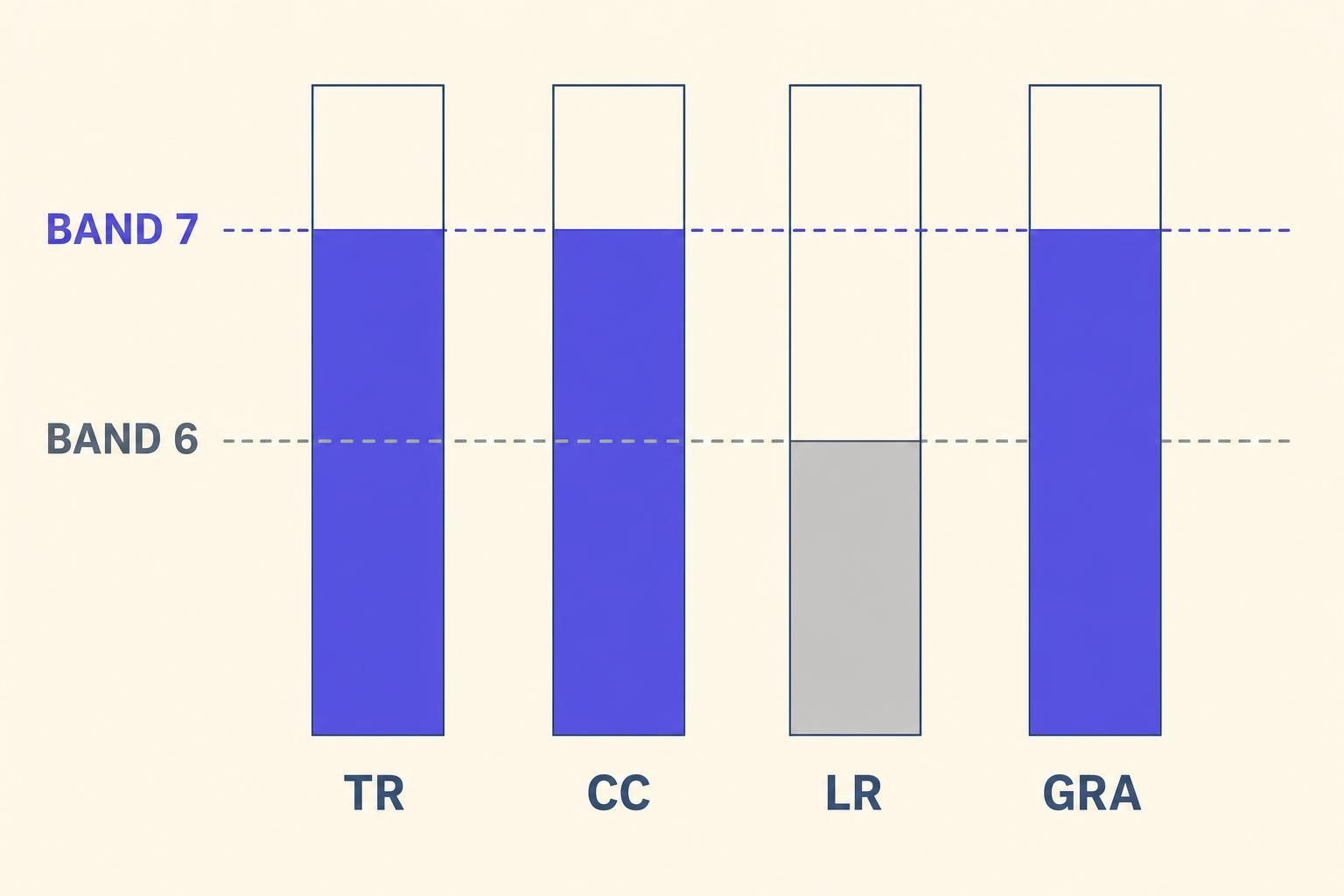
All four criteria have to reach 7. The useful question is which one is currently a 6.
Every Writing answer is marked on four criteria. In Task 2 they are Task Response, Coherence and Cohesion, Lexical Resource, and Grammatical Range and Accuracy. In Task 1 the first of those is called Task Achievement instead, and the other three are identical. Each criterion is scored as a whole band — there is no 6.5 for an individual criterion. Half bands appear only after the four are averaged.
That structure turns band 7 into eight checkable statements, two per criterion. If any one of them is false in your essay, the criterion it belongs to is describing band 6.
Everything below takes those eight apart and quotes the descriptor line each one comes from. All quotations are from the public band descriptors updated in May 2023 — IELTS Writing band descriptors explained holds the full scales for every criterion from band 5 to band 8.
The criteria are weighted equally and the task score is their average. That one sentence explains most of the frustration of the 6.5 plateau: three strong criteria cannot rescue a weak one, because nothing in the arithmetic gives them extra weight.
Three combinations, all from essays their writers described as "nearly there":
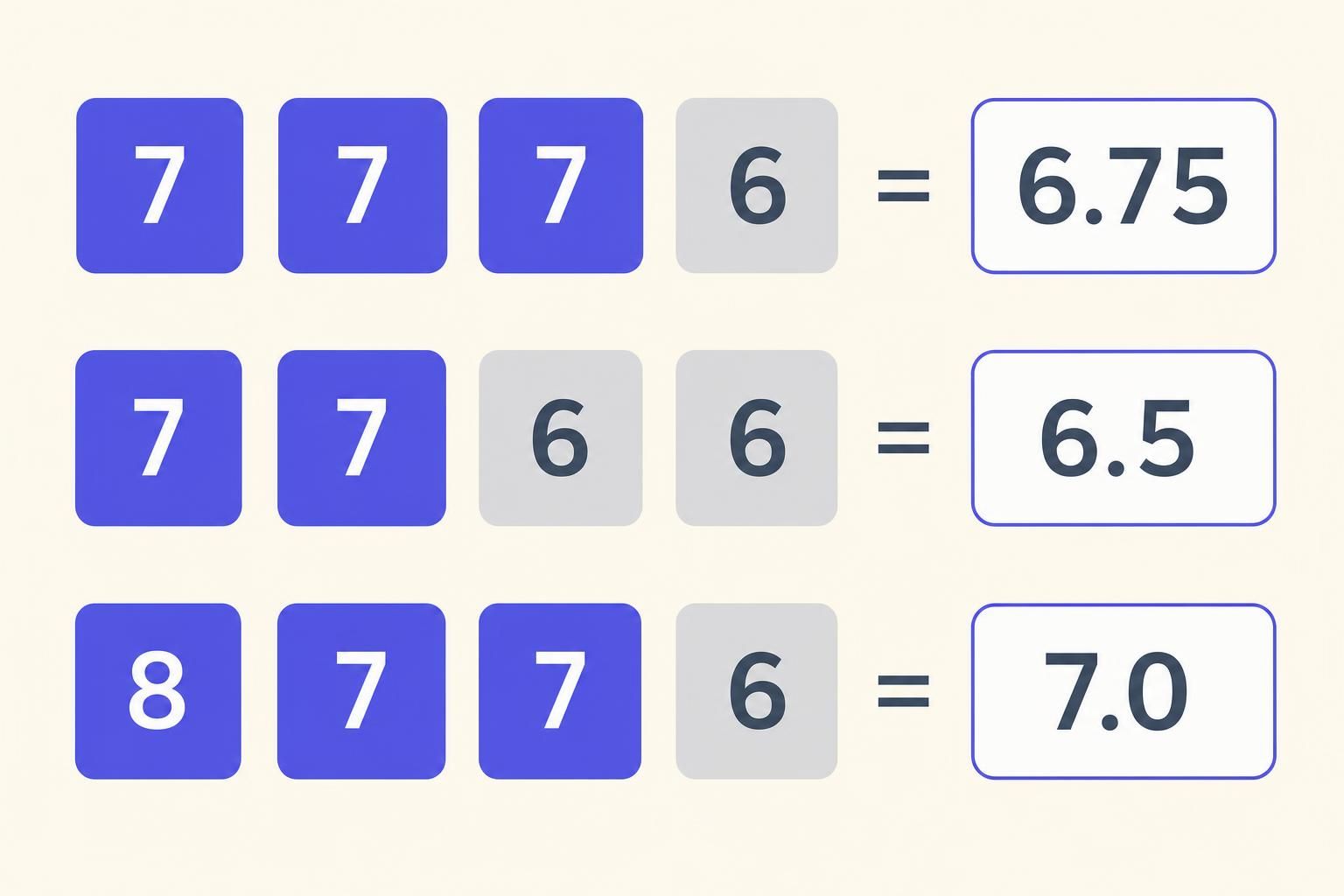
Three strong criteria cannot rescue a weak one. Nothing in the arithmetic gives them extra weight.
Two things follow. First, the route from 6.5 to 7 is almost never "write better essays" in general — it is raising one criterion by one band while holding the others still. Second, effort spent pushing an already-strong criterion from 7 to 8 buys you the same arithmetic as raising a 6 to a 7, at several times the cost.
One caution about the numbers. IELTS publishes the descriptors and the statement that the criteria are averaged, but it does not publish a table showing how a four-criterion average becomes the reported task score. Treat 6.75 as "not yet 7" rather than as a figure you can convert with confidence. Above the individual tasks, IELTS states only that "Task 2 contributes twice as much as Task 1 to the Writing score", which is why a weak criterion in Task 2 costs roughly twice what the same weakness costs in Task 1.
The band 7 wording is:
"The main parts of the prompt are appropriately addressed. A clear and developed position is presented. Main ideas are extended and supported but there may be a tendency to over-generalise or there may be a lack of focus and precision in supporting ideas/material."
Four separate requirements are packed into that, and they fail in different ways.
The main parts of the prompt are appropriately addressed. Two-part questions are where this is lost. Band 6 wording allows for parts being addressed "though some may be more fully covered than others" — which describes exactly the essay that gives one part three paragraphs and the other a closing sentence. Count the parts of the question before you plan, and give each one its own body paragraph.
A clear and developed position is presented. Band 6 asks only that a position be presented. Band 7 adds developed. Stating a view in the introduction, arguing near it for three paragraphs and restating it in the conclusion satisfies the first word and fails the second. A developed position changes shape as the essay proceeds: it acquires conditions, scope, a concession it survives.
Main ideas are extended. An extended idea goes somewhere. "Public transport reduces congestion" is a claim; extending it means saying what follows from it, for whom, under what conditions.
Main ideas are supported. Support is specific. The descriptor names the band 7 weakness itself — "a tendency to over-generalise" — so the failure mode to watch for is support that would be equally true of any essay on any topic.
Notice what the band 7 line does not say. It does not require a position held "throughout the response"; that phrasing belongs to the pre-2023 descriptors and is still quoted widely.
Band 7:
"Information and ideas are logically organised, and there is a clear progression throughout the response. A range of cohesive devices including reference and substitution is used flexibly but with some inaccuracies or some over/under use."
Band 6:
"Cohesive devices are used to some good effect but cohesion within and/or between sentences may be faulty or mechanical due to misuse, overuse or omission."
Read the band 6 line again. Overuse is named as a fault, in the official wording, at the band you are trying to leave. The widespread advice to add more linking phrases is advice to write the band 6 descriptor more thoroughly.
There is a test for this that takes two minutes. Delete every Firstly, Moreover, In addition and On the other hand from a paragraph you have written. If the sentences still follow one another in a fixed order, your cohesion is in the content and the connectors were labels on something already there. If the paragraph collapses into a list, the connectors were doing the work — and that is what "mechanical" describes.
What band 7 adds is named explicitly, which is unusual for the descriptors: reference and substitution. Reference is pointing back — this pattern, such schemes, the same objection. Substitution is replacing a repeated element rather than restating it — the second does too, those in the first group. Both create cohesion across sentences without a single connective, and both are learnable in an afternoon.
Band 7:
"The resource is sufficient to allow some flexibility and precision. There is some ability to use less common and/or idiomatic items. An awareness of style and collocation is evident, though inappropriacies occur."
Three phrases in that sentence are worth slowing down for.
Some ability, not consistent ability. The bar is not a vocabulary that performs at a high level throughout; it is a vocabulary that can reach past the obvious word when the meaning calls for it.
Though inappropriacies occur. Band 7 explicitly tolerates wrong word choices. Candidates who write defensively — choosing only words they are certain of — are protecting against something the descriptor already forgives, and paying for it in the range the same descriptor requires.
Style and collocation. This is where precision actually lives. Knowing a rare word is not the qualification; knowing which words it sits beside is. "Heavy rain" and "strong rain" involve the same difficulty of vocabulary and a different band of control.
Compare the band 6 line: "The meaning is generally clear in spite of a rather restricted range or a lack of precision in word choice." The two named faults are restricted range and imprecision — and of the two, imprecision is the one candidates rarely audit, because their own meaning is clear to them.
The practical move is to write the plain sentence first and then upgrade only the words where a more exact one exists. Upgrading everything produces the essay that reads as though it were assembled from a thesaurus, which is imprecision by another route.
Band 7:
"A variety of complex structures is used with some flexibility and accuracy. Grammar and punctuation are generally well controlled, and error-free sentences are frequent."
Two requirements, and most candidates satisfy one at the expense of the other.
The band 6 wording states the trap outright: "A mix of simple and complex sentence forms is used but flexibility is limited. Examples of more complex structures are not marked by the same level of accuracy as in simple structures." That is the profile of someone reaching for range and paying for it in accuracy. The two cancel, and the script stays at 6.
The other failure is the mirror image. A candidate writes fifteen short, safe, correct sentences and finds the score has not moved. Nothing there is wrong, and nothing there is "a variety of complex structures" either. Accuracy alone does not reach the band 7 line.
Note the unit in the accuracy clause: it counts sentences, not mistakes. One misplaced comma disqualifies a whole sentence from the error-free count, however sophisticated the rest of it is. That is why proofreading beats ambition in the last five minutes — a single correction can convert a sentence, and no amount of added complexity can.
How frequent is "frequent"? There is no published number, and any page giving you a percentage has invented it. What is published is the band above: band 8 requires that "The majority of sentences are error-free". Frequent sits below a majority, which is as much precision as the documents offer.
Take an essay you have written and answer these in order. The first "no" is where your work is.
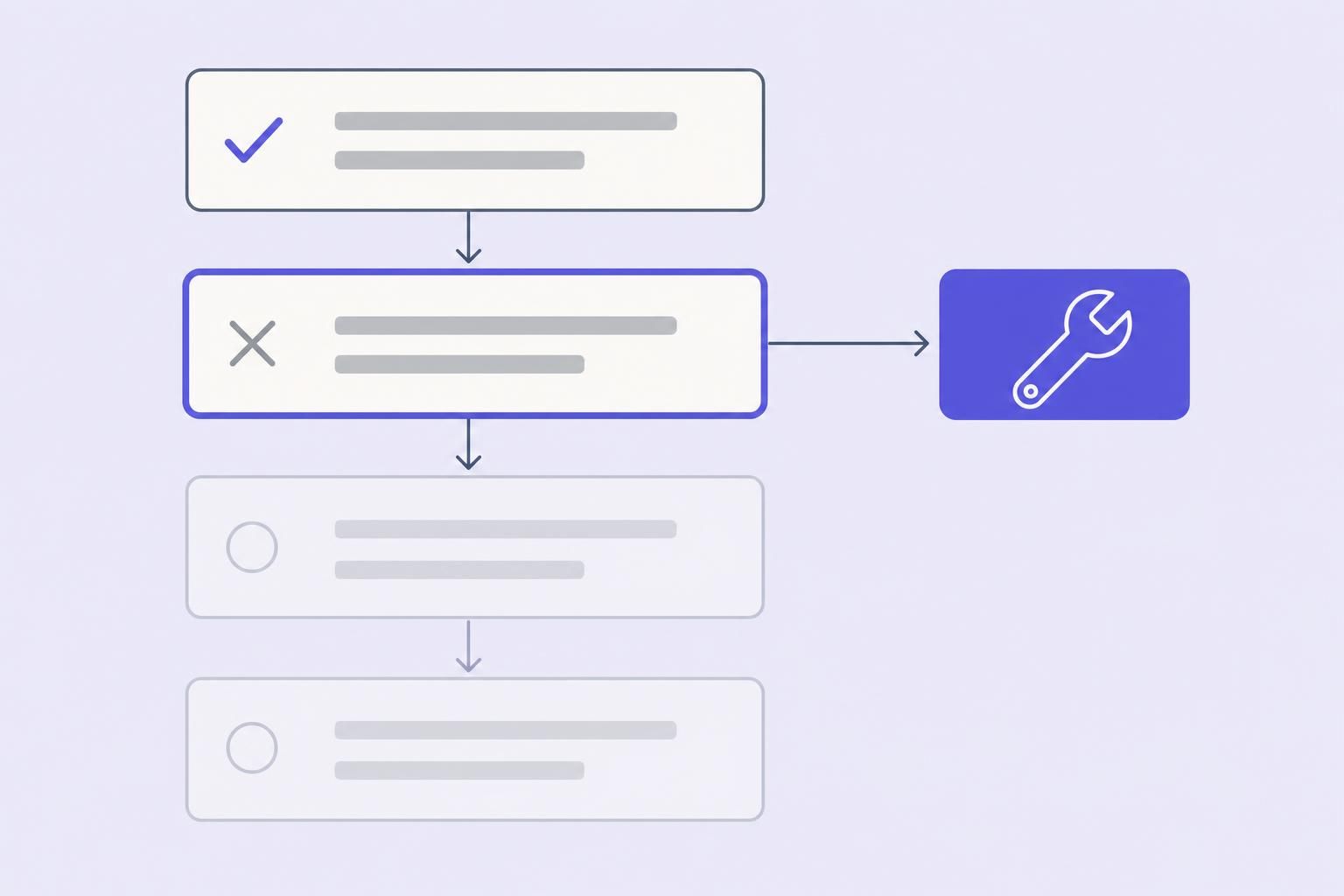
Work down the list and stop at the first "no". That criterion is where the band is being lost.
Does every main part of the question have its own body paragraph? If not, start with Task Response. It is the highest-leverage criterion because Task 2 carries twice the weight of Task 1, and prompt coverage is the fastest thing on this list to fix — it is a planning habit, not a language skill.
With the connectors deleted, does each paragraph still read in a fixed order? If not, start with Coherence. Practise reference and substitution; the descriptor names them, so you are working on exactly what is scored.
In your last essay, can you find three places where a more exact word existed and you used the general one? If yes, start with Lexical Resource, and work on precision rather than on acquiring more words.
Can you find five consecutive sentences with nothing wrong in any of them? If not, start with Grammar — and start with accuracy, not range, because errors in complex structures are the band 6 signature.
If two criteria come up, take the one where the gap is a habit rather than a skill. Prompt coverage and proofreading change within a week. Range of structure and precision of vocabulary do not, and trying to move them all at once is how the plateau extends.
Each of these is standard advice, and none of them appears in the band 7 descriptors.
Advanced vocabulary throughout. The wording is "some ability to use less common and/or idiomatic items". Some ability. A band 7 script can be mostly plain.
Idioms. They are named at band 7 as one option in an "and/or", and they disappear from the band 8 wording entirely, which asks instead for "A wide resource … fluently and flexibly used to convey precise meanings". Reaching for idiom to signal a high band is aiming at the lower one.
300 words. The published requirement for Task 2 is "at least 250 words", written in a recommended "no more than 40 minutes". Long essays are penalised only indirectly, through the errors and the thin support that haste produces.
Real statistics. Nothing in Task Response requires your examples to be factually verifiable. Support has to be specific and relevant; it does not have to be sourced. Inventing plausible figures is not rewarded, and it is not required either.
Five paragraphs. No paragraph count appears anywhere in the descriptors. Coherence asks for logical organisation and clear progression, which a four-paragraph essay can deliver and a five-paragraph essay can fail.
Perfect grammar. Band 7 asks for error-free sentences to be frequent. Even band 8 expects errors, requiring only that most sentences be free of them.
What band 7 does require is on the list of eight above, and none of it is on this list.
Every quotation on this page is from these documents, all free to read in full.
If a page quotes a descriptor line that does not appear in the May 2023 version, it is working from the superseded wording — and the band 7 Task Response line is the one that changed.
Bandly grades your essay or letter against all four criteria and shows the gap to your target band, sentence by sentence.
A band score checker can estimate your four IELTS writing criteria but not predict your test score. What it can judge, what it can't, and how to pick one.
You can check if your IELTS essay is band 7 before the exam, but only criterion by criterion. A four-pass self-check, its two blind spots and a timeline.