Criteria
How accurate are AI IELTS writing scores compared with a real examiner?
AI IELTS writing scores are not equally accurate across the four criteria. Where AI marking tracks an examiner, where it drifts, and how to use it.
11 min read
Two answers to one Task 2 question, one scored band 6.5 and one band 7, marked on all four criteria so you can see exactly where the half band goes.
The difference between a band 6.5 and a band 7 essay is rarely vocabulary or grammar. In almost every case the half band is lost on Task Response and Coherence and Cohesion — on whether the position is actually developed and whether the paragraphs move forward — and the two answers below show that happening on the same question.
Both essays were written to the same prompt and marked the way an examiner marks: four criteria, scored separately, then averaged for the task. Read them first, then read the criteria table, and the gap stops looking mysterious.
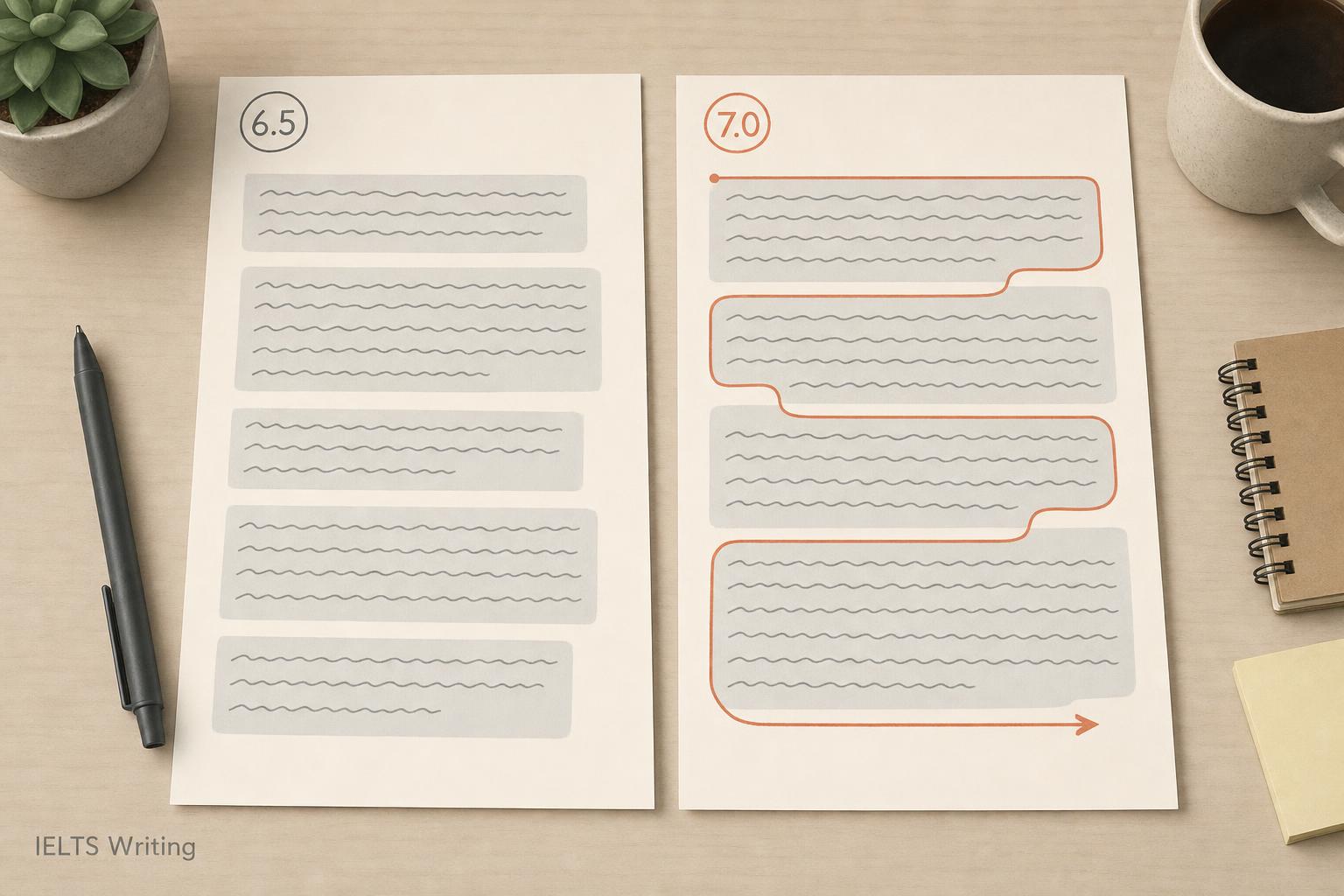
The same question, two answers. The half band is not in the words — it is in whether the paragraphs are connected by an argument.
An examiner does not award one impression score. Task 2 is marked on four criteria, each on the 9-band scale:
The four are averaged to give the Task 2 score. Task 2 is then weighted against Task 1 for the Writing band: (Task 1 + Task 2 × 2) / 3, rounded in 0.25 steps. The practical consequence is that a single weak criterion in Task 2 costs you roughly twice what the same weakness costs in Task 1.
The full public criteria are published by IELTS: IELTS Writing band descriptors and key assessment criteria. For a line-by-line reading of all four scales, see IELTS Writing band descriptors explained.
Task 2. Some people believe that governments should spend more money on improving public transport than on building new roads. To what extent do you agree or disagree?
Nowadays traffic is a serious problem in many cities around the world. In my opinion, I agree that governments should spend more money on public transport instead of building new roads, because it is better for the environment and for citizens.
Firstly, public transport is more environmentally friendly. When many people take a bus or a subway, the number of private cars on the road decreases, so the air pollution is reduced. For example, in a large city like Seoul the subway system carries millions of passengers every day, and without it the city would have much more traffic and much more pollution. Therefore, investing in public transport is a good solution for the environment.
Secondly, building new roads is not a real solution. When a new road is built, more drivers start to use it, and after a few years the traffic situation is the same as before. Moreover, new roads are very expensive and they take a lot of space in the city centre.
On the other hand, some people say that new roads are necessary for economic development, because trucks and delivery companies need good roads to transport their goods. This is a reasonable point, but the government can repair the existing roads instead of building new ones.
In conclusion, I strongly agree that spending money on public transport is better than building new roads. Governments should improve buses and subways, and also they should think more about the environment, because it is the most important problem of our generation.
Governments with limited transport budgets have to choose between widening the road network and improving buses, trams and rail. I agree that public transport should take the larger share, mainly because it moves more people through the same space and because road building tends to generate the very traffic it is meant to relieve.
The strongest argument for prioritising public transport is capacity. A single lane of road carries a few thousand cars an hour, whereas the same width given to a rail track or a dedicated bus lane carries several times that number of passengers. In dense cities, where land is the scarcest resource of all, that difference decides whether the network can absorb population growth at all. Money spent on frequency, reliability and coverage therefore buys far more mobility than the same money spent on asphalt.
Road building also has a well-documented weakness: it changes behaviour. Once a route becomes faster, journeys that were previously avoided, or made at inconvenient hours, return to it, and congestion drifts back towards its earlier level within a few years. The relief is real but temporary, while a rail line or a bus corridor keeps carrying the same volume long after demand has settled.
None of this means road spending should stop. Freight, emergency access and rural communities depend on roads that are safe and properly maintained, and neglecting maintenance in order to fund new rail projects would simply move the problem elsewhere. The sensible division is maintenance for roads and expansion for public transport.
Overall, I agree that public transport deserves the greater investment, because it uses limited urban space more efficiently and because its benefits, unlike those of new roads, do not erode over time.
| Criterion | Essay A | Essay B | What made the difference |
|---|---|---|---|
| Task Response | 6 | 7 | A states two reasons but extends neither; the counter-argument is dismissed in one clause and the conclusion introduces a new claim. B extends both reasons and folds the counter-argument into its position. |
| Coherence and Cohesion | 6 | 7 | A signposts with Firstly / Secondly / Moreover, and the order of ideas would survive being shuffled. B carries cohesion through reference and repeated key nouns, and each paragraph advances the previous one. |
| Lexical Resource | 7 | 7 | Both show range with occasional imprecision. A: "the air pollution", "take a lot of space". B: "asphalt" is slightly informal for the register. No difference at band level. |
| Grammatical Range and Accuracy | 7 | 7 | Both use a mix of complex forms with a majority of error-free sentences. A slips on word order ("and also they should think"); B has no error that affects meaning. |
| Task 2 score | 6.5 | 7.0 | Average of the four criteria |
Read the table in one direction only: the half band came entirely from TR and CC. Essay A's writer almost certainly believed the problem was vocabulary, because that is what feels weak from the inside. It was not.
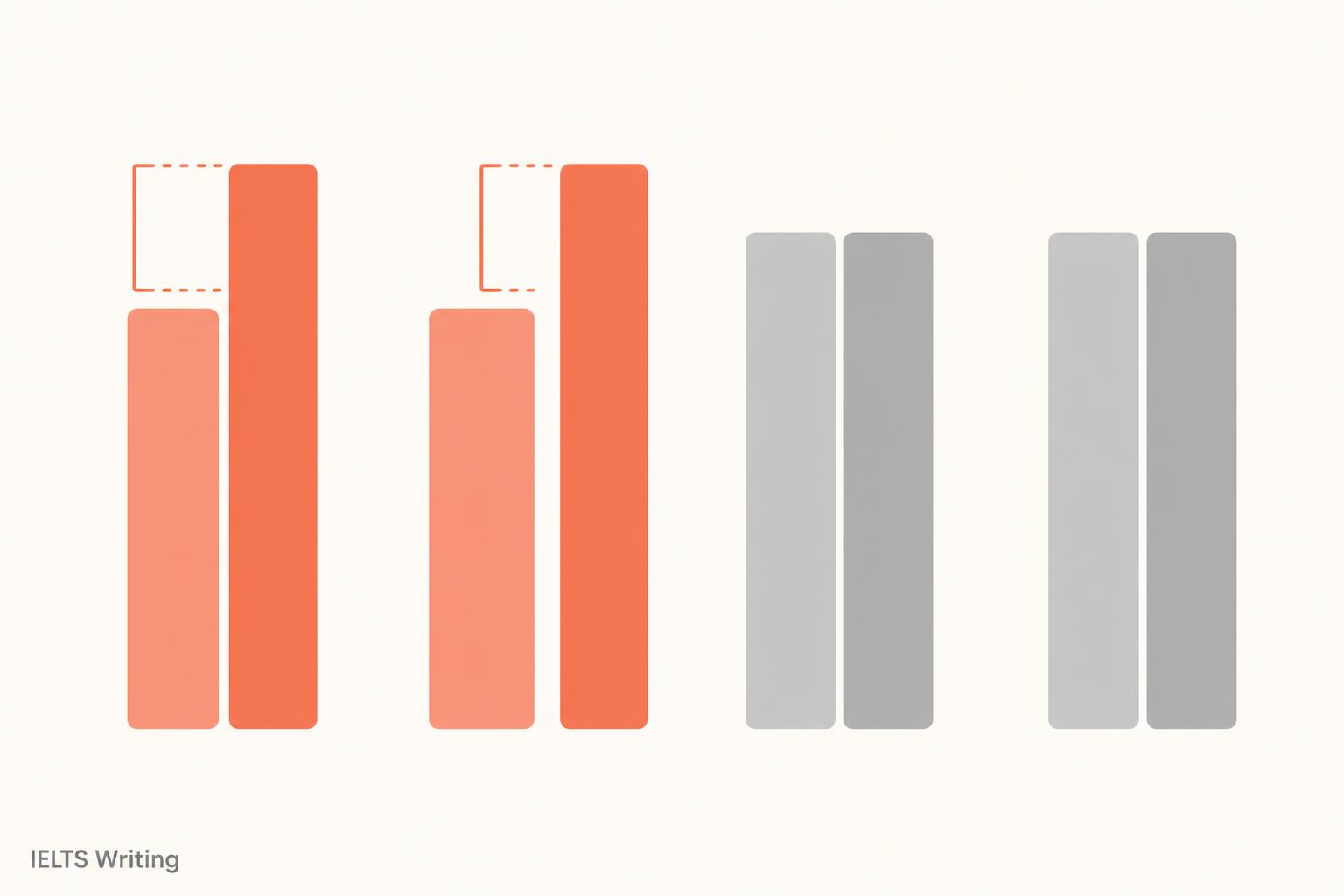
The whole half band sits in the first two pairs. Lexical Resource and Grammatical Range and Accuracy are identical.
Why Essay A is a 6.5, one line per criterion
Why Essay B is a 7, one line per criterion
1. Extend the second reason instead of adding a third. Essay A's claim that new roads fill up again is correct but stops at assertion. Band 7 needs the mechanism: faster route, suppressed journeys return, congestion recovers. One extra sentence of causal explanation does more for TR than an entire extra paragraph of new points.
2. Delete the linkers and rebuild the joins. Remove Firstly, Secondly, Moreover and Therefore, then reconnect the sentences using the nouns already in play — that difference, the relief, this. If the paragraph collapses without the signposts, the underlying progression was never there, and that is precisely what CC 6 describes.
3. Resolve the counter-argument in your own terms. Essay A concedes that freight needs roads, then walks away from it. Essay B ends the same paragraph with a division of the budget — maintenance for roads, expansion for public transport — which converts a concession into evidence of a considered position.
Notice that none of the three edits involves a longer word. Candidates stuck at 6.5 almost always spend their preparation on the two criteria that were already at 7. How to get band 7 in IELTS Writing takes the same four criteria apart as conditions your essay has to meet, which is the more useful direction to work in.
Three things a band 7 essay is not obliged to do, and worrying about them costs writing time:
The one thing band 7 does require is a position you can still see in the final sentence. Both essays above agree with the prompt; only one of them argues for it the whole way through. The wording those judgements come from — attempted against achieved, presented against developed — runs through every criterion, and the band descriptors post traces the same ladders from band 5 to band 8.
Self-assessment fails in a predictable direction: writers mark their own grammar hard and their own task response generously, because the ideas were clear inside their head before they were on the page. The fix is to mark against the four criteria separately, exactly as the table above does, and to check whether the position in the last paragraph is still the position in the first.
Paste your own answer into the scorer, get a band for each of TR, CC, LR and GRA, and see which one is holding the total at 6.5.
Bandly grades your essay or letter against all four criteria and shows the gap to your target band, sentence by sentence.
AI IELTS writing scores are not equally accurate across the four criteria. Where AI marking tracks an examiner, where it drifts, and how to use it.
A band score checker can estimate your four IELTS writing criteria but not predict your test score. What it can judge, what it can't, and how to pick one.