Criteria
Why did my IELTS writing score drop on the retake?
A lower band on the second attempt is rarely a step backwards. Here is the arithmetic that produces it, and the three changes that usually cause it.
11 min read
There is no fixed off-topic penalty in IELTS writing. Going off topic caps Task Response, and here is what each level of drift costs on the report.
Going off topic in IELTS writing does not trigger a penalty. There is no deduction, no fixed number of bands removed, and no separate rule an examiner applies. What happens is narrower and more mechanical: an essay that does not answer the prompt in front of it fails the Task Response descriptors, and Task Response is one of four criteria that are averaged to produce the band for that task.
That distinction matters, because it decides how much a drift costs. A partially answered prompt and a wholly unrelated one are not the same event. Below is what the public descriptors say about each level of drift, what the arithmetic does to your reported band, how examiners notice, and what to check on your own essay before you hand it in.

Off topic is not a deduction. It is a Task Response judgement.
Examiners do not mark an essay and then subtract something for relevance. They read the script once for each criterion and choose, for each one, the descriptor level that is the best fit for what the script does. Relevance to the prompt lives inside a single criterion — Task Response in Task 2, Task Achievement in Task 1, a distinction set out in Task Achievement vs Task Response.
Two consequences follow, and they pull in opposite directions.
The first is reassuring. The other three criteria are marked on the text you actually wrote, not on the essay you should have written. Coherence and Cohesion, Lexical Resource and Grammatical Range and Accuracy do not ask what the question was. A fluent, well organised essay about the wrong thing keeps most of the credit it earned in those three.
The second is not. Because Task Response is one of four criteria averaged for that task, a low Task Response cannot be offset. Even excellent language on the other three leaves the task average dragged down by a quarter of the distance, and Task 2 then carries double weight into the reported band.
So the useful question is never "how many bands do I lose for going off topic". It is "which Task Response descriptor does this script fit", and the ladder between those descriptors is short.
The public band descriptors do not use the phrase "off topic" at all. They describe a sequence of increasingly weak relationships between the script and the prompt, and each step down is a whole band.
Band 6 — "The main parts of the prompt are addressed (though some may be more fully covered than others)." This is the normal working band for an essay that answers everything but answers one half thinly. It is not off topic.
Band 5 — "The main parts of the prompt are incompletely addressed." One demand of a two-part question has gone unanswered, or a body paragraph carries material the prompt did not ask for. The descriptor also allows for "irrelevant detail" inside an otherwise relevant answer.
Band 4 — "The prompt is tackled in a minimal way, or the answer is tangential, possibly due to some misunderstanding of the prompt." Tangential is the key word. This is the band for an essay written on the general subject area rather than the actual question — a prompt about whether governments should fund public transport answered with an essay about traffic and pollution.
Band 3 — "No part of the prompt is adequately addressed, or the prompt has been misunderstood."
Band 2 — "The content barely relates to the prompt."
Band 1 — "The content is wholly unrelated to the prompt." Band 1 also applies to responses of 20 words or fewer, and copied rubric is discounted before the answer is judged, so restating the question at length does not buy relevance or length.
Band 0 is reserved for a script that did not attempt the task at all, was written in another language, or is shown to be a totally memorised response.
Most essays that candidates worry about are somewhere between band 6 and band 4. The full wording for all four criteria across the working range is in IELTS Writing band descriptors explained.
Take an essay that would otherwise sit at band 6.5 overall and put a partial drift into Task 2 — one part of the prompt answered properly, the second answered with material about the general subject instead.
The four Task 2 criteria before the drift: Task Response 6, Coherence and Cohesion 6, Lexical Resource 7, Grammatical Range and Accuracy 7. That averages 6.5. With Task 1 also at 6.5, the reported band is:
(6.5 + 6.5 × 2) / 3 = 6.5
Now the drift. Task Response falls from 6 to 4, because one main part of the prompt is only tackled tangentially. Coherence and Cohesion follows it down from 6 to 5, since a paragraph that argues something the prompt did not ask makes the position harder to follow. Lexical Resource and Grammatical Range and Accuracy do not move — the sentences are the same sentences.
(4 + 5 + 7 + 7) / 4 = 5.75
(6.5 + 5.75 × 2) / 3 = 6.0
Half a band, from one paragraph aimed at the wrong target, with no loss of language quality anywhere in the script. Push Task Response to 2 or 1 and the same arithmetic gets much steeper: even with Lexical Resource and Grammatical Range and Accuracy holding at 6, a Task 2 with Task Response at 1 and Coherence and Cohesion at 2 averages 3.75, and a task average that low cannot be rescued by Task 1 at any level, because Task 2 is two-thirds of the total.
The general shape of that weighting — and why Task 1 losses hide inside it — is in I get 7 in Task 1 but 6.5 in Task 2.
Relevance is not something an examiner hunts for at the end. It is visible in the reading.
The position does not answer the question asked. An examiner reads the prompt, then reads your introduction and conclusion looking for a position that responds to it. A thesis that answers a nearby question — whether something is a problem, when the prompt asked what should be done about it — is apparent before the body paragraphs are read at all. What a position that lands actually looks like is in Task 2 introduction examples for band 7.
The topic vocabulary belongs to a different prompt. A prompt sets a small set of terms. When the essay's content words come from the general subject area rather than from the prompt's own framing, the mismatch shows up quickly, and it is a reliable sign of prepared material being fitted to a question it was not written for.
One demand is never mentioned again. Two-part prompts — discuss both views and give your own opinion, causes and solutions, to what extent plus a second question — leave a gap that is easy to see, because one of the two demands has no paragraph attached to it.
The register or the argument jumps. A memorised paragraph usually sits a band above the writing around it and answers a slightly different question. That seam reads as two texts spliced together, and it is what the band 0 rule about totally memorised responses is aimed at.
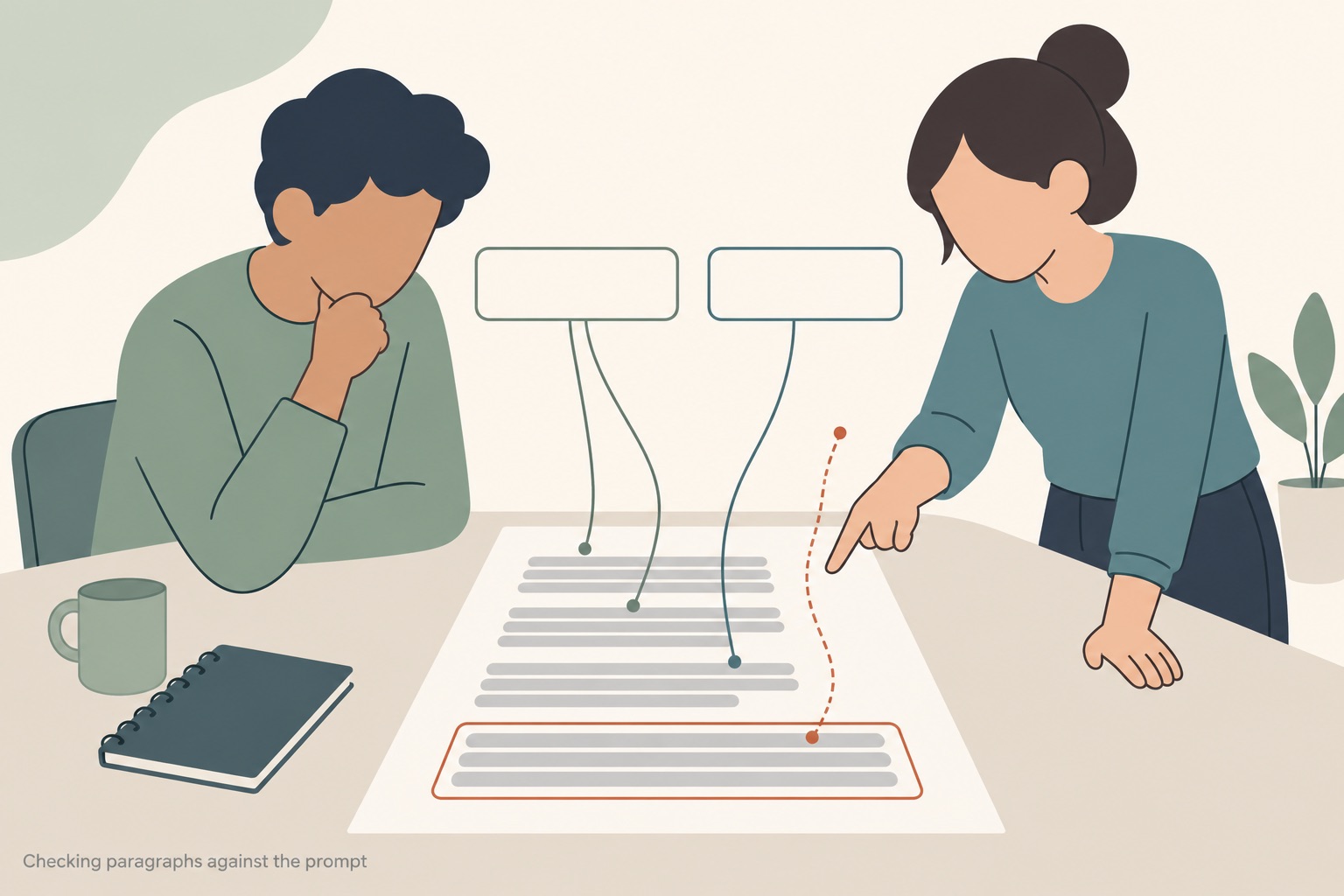
Every paragraph should trace back to something the prompt asked for.
Almost every off-topic script comes from one of these, and they carry different costs.
Answering the subject instead of the question. The most common by a distance. The prompt names a topic and asks something specific about it; the essay discusses the topic. An essay about the benefits and drawbacks of remote work is not an answer to a prompt asking whether employers should be required to allow it. This is the tangential case, which is band 4 territory, and it is expensive because it usually runs through the whole script rather than one paragraph.
Dropping half of a two-part prompt. Usually a timing failure rather than a misreading — the second demand was going to be paragraph three, and paragraph three never got written. This caps Task Response around band 5, and it is the cheapest of the four to prevent.
Drifting mid-essay. The introduction and the first body paragraph answer the prompt, then an example takes over and the rest of the essay follows the example rather than the argument. The essay ends up answering a question that grew out of its own third paragraph. Task Response typically lands at 5, sometimes 4 if the conclusion drifts too.
Reusing prepared material. A practised paragraph, a memorised introduction, or an essay learned whole for a similar prompt. The relevance loss is the same as the tangential case, and the risk is worse: a script judged to be a totally memorised response is a band 0 matter rather than a low Task Response.
There is a fifth failure that is not off topic but often gets blamed on it. If you notice the drift with ten minutes left and restart, the finished script is likely to be short, and an underlength answer costs marks on its own terms — what really happens under 250 words sets out what that costs. Redirecting the essay you already have is nearly always the better trade.
Three checks, none of which take more than a minute.
Underline the demands in the prompt before you plan. Most prompts contain one or two verbs that state what you must do — discuss, evaluate, suggest, agree or disagree, say to what extent. Marking them takes seconds and prevents the two most expensive failures on the list.
Trace each body paragraph back to a demand. Point at each paragraph in turn and name which underlined demand it answers. A paragraph that cannot be traced to one is the paragraph the examiner will read as irrelevant detail, or worse.
Check that your conclusion answers the same question as your introduction. Mid-essay drift is invisible from inside the essay but obvious when the first and last paragraphs are read together. If they answer different questions, the drift happened somewhere in the middle and you can find it.
If you are working from a returned band rather than a script in front of you, the relevant question is which criterion moved rather than whether the essay felt on topic. A Task Response sitting well below your other three criteria is the signature of a drift, and the criterion patterns that produce a stuck result are in why am I stuck at band 6.5. A criterion-by-criterion assessment of a practice essay written to a prompt you have not seen before is the only way to find out whether your Task Response holds under exam conditions.
Is there a fixed penalty for going off topic in IELTS writing?
No. There is no deduction and no fixed number of bands removed. Relevance to the prompt is judged inside one criterion — Task Response in Task 2, Task Achievement in Task 1 — and going off topic means that criterion is awarded a lower band. The cost then depends on how far the answer strayed and how the four criteria average out.
Can I still get a good band if my essay is off topic?
Only partially. The other three criteria are marked on the text you wrote, so strong language keeps its credit there. But Task Response is a quarter of the task average and Task 2 counts double, so a Task Response of 4 in Task 2 is usually worth about half a band off the reported score even when nothing else moves.
What is the lowest band an off-topic essay can get?
Band 1 for Task Response, which applies when the content is wholly unrelated to the prompt. Band 0 is not for off-topic answers as such — it is for a script that did not attempt the task, was written in another language, or is shown to be a totally memorised response.
Does answering only one part of a two-part question count as off topic?
It is judged on the same criterion, at a milder level. The band 5 descriptor covers a prompt whose main parts are incompletely addressed, so a missing second part typically caps Task Response around 5 rather than pushing it into the tangential band.
Will my grammar and vocabulary scores drop if I go off topic?
Not directly. Lexical Resource and Grammatical Range and Accuracy are assessed on the language in the script regardless of what it argues. Coherence and Cohesion often does slip, because a drifting essay is harder to follow as a single line of argument.
Are the band estimates on this site official?
No. They are estimates made against the public band descriptors. Only a certified examiner produces an official band.
All descriptor wording quoted here is from the public Writing band descriptors updated in May 2023, published by IELTS and the British Council.
Bandly grades your essay or letter against all four criteria and shows the gap to your target band, sentence by sentence.
A lower band on the second attempt is rarely a step backwards. Here is the arithmetic that produces it, and the three changes that usually cause it.
There is no deduction for an IELTS essay under 250 words. Here is what a short script costs you under each of the four criteria, with an answer marked.