Criteria
IELTS writing band score checkers: what they can and cannot tell you
A band score checker can estimate your four IELTS writing criteria but not predict your test score. What it can judge, what it can't, and how to pick one.
11 min read
Task Achievement marks Task 1; Task Response marks Task 2. The official band 6-8 wording for both, side by side, and what each one is actually asking for.
Task Achievement and Task Response are two different criteria, not two names for one. Task Achievement is the first criterion for Writing Task 1; Task Response is the first criterion for Writing Task 2. The other three — Coherence and Cohesion, Lexical Resource, Grammatical Range and Accuracy — carry the same names in both.
That is worth stating plainly, because the two terms get used interchangeably in a great deal of preparation material, including on pages that rank well for this exact question. It also makes a useful test of a source: if you are reading advice about "Task Response" in an article about bar charts, that page is not working from the descriptors.
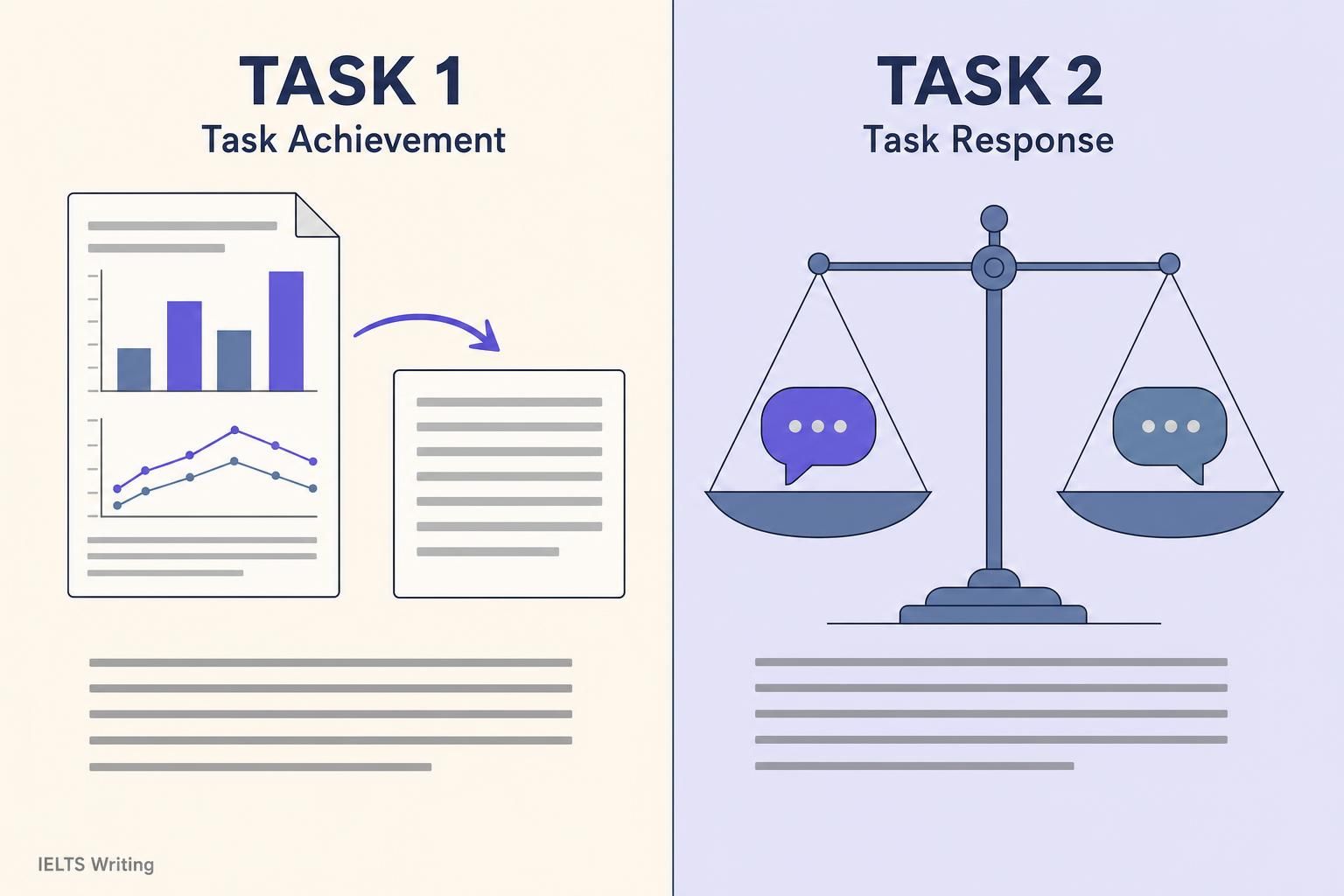
Task 1 asks you to convey information you were given. Task 2 asks you to respond to a proposition. The criteria are named after the difference.
The official criteria for Task 1 are Task Achievement, Coherence and Cohesion, Lexical Resource, and Grammatical Range and Accuracy. For Task 2, the first of those is replaced by Task Response and the rest are unchanged.
The naming is not arbitrary. Task 1 gives you information — a chart, a diagram, a situation — and asks you to convey it. What is marked is whether you achieved the transfer: selected the right features, categorised them, got the figures right. Task 2 gives you a proposition and asks what you think. What is marked is whether you responded: covered the parts of the question, took a position, developed it.
One further split sits inside Task Achievement. General Training Task 1 is a letter, so its descriptor carries clauses about purpose and tone that the Academic version does not have. That leaves three distinct sets of wording to keep straight, not two.
Here are all three, quoted from the public band descriptors updated in May 2023.
| Band | Task 1 Academic — Task Achievement | Task 1 General Training — Task Achievement | Task 2 — Task Response |
|---|---|---|---|
| 6 | "Key features which are selected are covered and adequately highlighted. A relevant overview is attempted." | "The purpose is generally clear. There may be minor inconsistencies in tone." | "The main parts of the prompt are addressed (though some may be more fully covered than others). A position is presented that is directly relevant to the prompt, although the conclusions drawn may be unclear, unjustified or repetitive." |
| 7 | "The response covers the requirements of the task. The content is relevant and accurate – there may be a few omissions or lapses. It presents a clear overview, the data are appropriately categorised, and main trends or differences are identified." | "All bullet points are covered and clearly highlighted… It presents a clear purpose. The tone is consistent and appropriate to the task. Any lapses are minimal." | "The main parts of the prompt are appropriately addressed. A clear and developed position is presented. Main ideas are extended and supported but there may be a tendency to over-generalise or there may be a lack of focus and precision in supporting ideas/material." |
| 8 | "The response covers all the requirements of the task appropriately, relevantly and sufficiently." | "All bullet points are clearly presented, and appropriately illustrated or extended." | "The prompt is appropriately and sufficiently addressed. A clear and well-developed position is presented in response to the question/s." |
Read across a row and the difference stops being a matter of terminology. The Task 1 columns are about coverage and accuracy of given content: key features, an overview, data categorised, figures right. The Task 2 column is about position and development: parts of the prompt, a clear position, ideas extended and supported. There is no overview anywhere in the Task 2 wording and no position anywhere in the Task 1 wording. They are not asking for the same thing in different words.
Read down a column and you get each criterion's own ladder. Task 1 Academic moves from an overview "attempted" at band 6 to a "clear overview" at 7. Task 2 moves from a position "presented" at 6 to one "clear and developed" at 7. The full band 5 to 8 scales for all four criteria are in IELTS Writing band descriptors explained.
Three separable demands sit inside the band 7 Academic wording.
Selection. The descriptor talks about covering the requirements of the task and about main trends or differences being identified. A chart usually contains more than can be described in 150 words, so the criterion is testing judgement about what matters, not stamina. Reporting every number is not a route to a high band; it is what produces a script with no overview in it.
Categorisation. "The data are appropriately categorised" is the clause candidates most often have no plan for. It means the body paragraphs are grouped by something meaningful — highest against lowest, rising against falling, one period against another — rather than walking through the categories in the order the chart happens to print them.
Accuracy. "The content is relevant and accurate – there may be a few omissions or lapses." Figures and trends have to be right, with a small allowance. This is the clause with no equivalent in Task 2: in Task 1 you can lose marks for misreading the source, because there is a source to misread.

Select, categorise, get the numbers right — the three demands the band 7 Academic wording separates out.
And then the overview. Band 6 says a relevant overview is "attempted"; band 7 says the response "presents a clear overview". Attempted is a band 6 word throughout the descriptors, which is a precise way of saying that having a go is scored below having done it.
The band 7 wording contains three demands, and none of them is about accuracy of content.
The main parts of the prompt are appropriately addressed. Band 6 allows the parts to be covered unevenly — "though some may be more fully covered than others" — which is exactly the essay that gives one half of a two-part question three paragraphs and the other a closing line. Count the parts before you plan.
A clear and developed position is presented. Band 6 asks only that a position be presented. The band 7 addition is developed: the position acquires scope, conditions, a concession it survives, rather than being restated at the end in different words.
Main ideas are extended and supported. The descriptor names its own band 7 weakness — "a tendency to over-generalise" — so the failure mode here is support that would be equally true of any essay on any topic.
Note what is absent. Nothing asks you to select key features, and nothing asks for factual accuracy. Task 2 examples do not have to be verifiable, because there is no given data to be faithful to.
General Training Task 1 is a letter, and its Task Achievement wording carries two requirements the Academic version has no equivalent of.
At band 7: "It presents a clear purpose. The tone is consistent and appropriate to the task. Any lapses are minimal." At band 6: "The purpose is generally clear. There may be minor inconsistencies in tone."
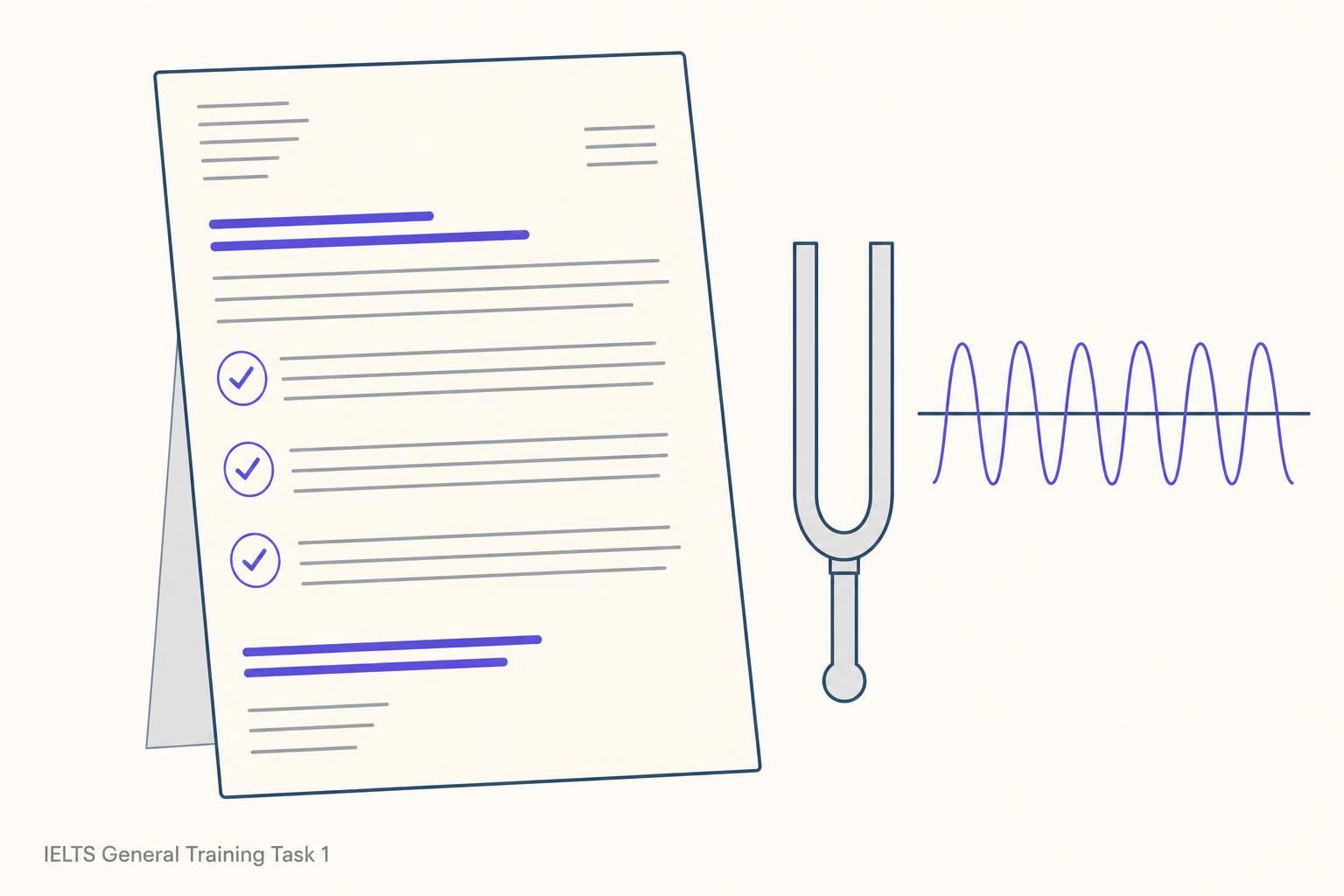
General Training Task 1 is a letter, so its Task Achievement wording adds a clear purpose and a consistent tone — neither of which appears in the Academic version.
Purpose means the reader knows within the first two lines what the letter is for and what it wants to happen. A letter that explains the situation for two paragraphs before arriving at the request has a purpose that is "generally clear" — band 6 wording — rather than a clear one.
Tone consistency is the clause that catches candidates who have prepared phrase banks. A formal complaint that opens "Dear Sir or Madam" and later says "it was a real pain" has a tone inconsistency, and the descriptor treats consistency as a band 7 condition, not a stylistic preference. The band 6 line explicitly allows minor inconsistencies; band 7 does not.
The band 7 wording also requires that all bullet points be covered and clearly highlighted — all of them, not most.
The confusion is not only terminological, because the two criteria reward opposite instincts.
Writing to the Task Response descriptor while doing Task 1 produces an answer with opinions and explanations in it — why the trend happened, what should be done about it. None of that appears in the Task Achievement wording, so it earns nothing, and it consumes the words the overview and the categorisation needed. It is not an automatic penalty; it is unrewarded content displacing rewarded content.
Writing to the Task Achievement descriptor while doing Task 2 produces the opposite: an essay that summarises the prompt and describes both sides neatly without ever presenting a position. Band 6 Task Response requires a position that is "directly relevant to the prompt". An essay with no position does not reach that line, however well organised it is.
There is also a weighting reason to care. IELTS states that "The assessment of Task 2 carries more weight in marking than Task 1", so mistaking the criterion in Task 2 is the more expensive error of the two. If your score is stuck below target, how to get band 7 in IELTS Writing takes all four criteria apart as conditions rather than advice.
Every quotation on this page is from these documents, all free to read in full.
If a page quotes a descriptor line that does not appear in the May 2023 version, it is working from the superseded wording.
Bandly grades your essay or letter against all four criteria and shows the gap to your target band, sentence by sentence.
A band score checker can estimate your four IELTS writing criteria but not predict your test score. What it can judge, what it can't, and how to pick one.
You can check if your IELTS essay is band 7 before the exam, but only criterion by criterion. A four-pass self-check, its two blind spots and a timeline.