Sample essays
Band 6 to band 7: the same essay rewritten, with every change explained
The same IELTS Task 2 essay at band 6 and band 7, with every edit tagged to the criterion it moved — and the averaging trap that keeps you at 6.5.
10 min read
A band 5.5 essay scored 5/6/5/6, plus the exact sentence holding each criterion down and the minimum fix that clears the band 6 line.
A band 5.5 in Writing is two criteria away from 6.0, not one level away. In the band 5.5 IELTS essay example below, two of the four criteria sit at band 5 and two already sit at band 6 — so the work is narrower than most candidates assume. What follows is the essay in full, the four scores that average to 5.5, and the exact sentence in each criterion that holds it there, matched against the public band descriptors.
One caveat first: the scores here are our estimate against the public descriptors, not an official IELTS result. Only a certified examiner produces the real number.
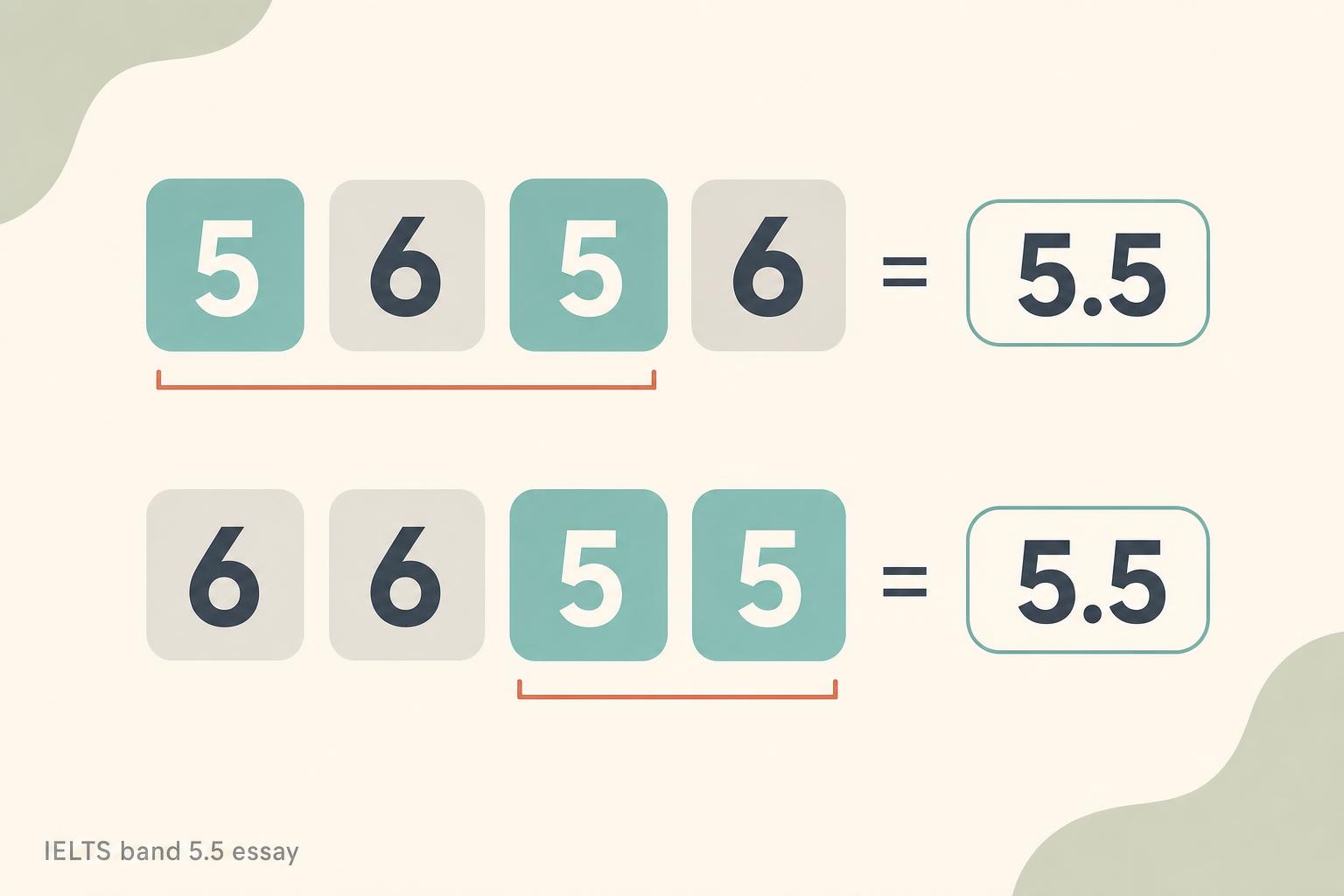
Two candidates, the same 5.5, completely different work to do. The reported band does not tell you which.
Both the answer and the prompt were written for this article. Neither is a real exam script or a real exam question — only the question type is reproduced. The answer runs 257 words, above the 250-word minimum.
Prompt: Some people think governments should spend money on public libraries, while others believe the money would be better spent on internet access for everyone. Discuss both views and give your own opinion.
In many countries, governments must decide how to use limited money. Some people think that money should be spent on public libraries, and other people think it is better to spend it on internet access for everybody. In this essay I will discuss both sides.
On the one hand, public libraries are very important for society. Libraries give books to people who cannot buy books, and this is very good for poor families. Also, libraries are a quiet place where students can study, because many students do not have a good place at home. In my country, many students go to the library every day before the exam. Furthermore, many libraries have free computers and free classes for old people, so they are helping a lot of different groups in the community. Therefore, libraries are very useful for education and for poor people, and the government should not close them.
On the other hand, some people say that internet access is more important. The internet has a lot of information and it is very fast. If everybody has internet, they can find information at home.
Moreover, the internet is used by companies and workers, so it is important for economy. However, the internet is also expensive for the government.
In conclusion, both public libraries and internet access are important things for a country. Governments should think carefully about this problem and choose the best solution for their people. I think that both of them have advantages and disadvantages, and it depends on the situation of each country.
A Writing band is not a single judgement. It is four judgements, one per criterion, and the reported band is their average. This essay scores:
| Criterion | Band |
|---|---|
| Task Response (TR) | 5 |
| Coherence and Cohesion (CC) | 6 |
| Lexical Resource (LR) | 5 |
| Grammatical Range and Accuracy (GRA) | 6 |
That is 5 + 6 + 5 + 6 = 22, divided by four, which is 5.5.
The part that matters for what you do next: 5.5 does not describe one problem. A 5/6/5/6 essay and a 6/6/5/5 essay both report as 5.5, and they need completely different work — the first has a content problem and a vocabulary problem, the second a vocabulary problem and a grammar problem. Anyone who tells you what to fix at 5.5 without seeing your four numbers is guessing.
So the first question is not "how do I write better essays" but "which two of my four scores are the fives". Everything below assumes the pattern above.
Band 5: "The main parts of the prompt are incompletely addressed. The format may be inappropriate."
Band 6: "The main parts of the prompt are addressed (though some may be more fully covered than others)."
Band 6 explicitly allows uneven coverage — one view can be thinner than the other. What it does not allow is a part of the prompt left unanswered.
This prompt has three parts: discuss view one, discuss view two, give your own opinion. The essay answers the first properly, the second thinly, and the third not at all:
I think that both of them have advantages and disadvantages, and it depends on the situation of each country.
"It depends" is not an opinion. It is the refusal to give one, phrased as if it were one. That single sentence is the difference between "addressed" and "incompletely addressed".
Minimum fix — replace that sentence, keep the rest of the conclusion:
In my opinion, governments should fund internet access first, because a household without a connection is cut off from services that libraries cannot replace, while a household with one can still reach a library later.
Two clauses, one committed position, one reason. No rewrite of the body needed.
Band 5: "The resource is limited but minimally adequate for the task."
Band 6: "The resource is generally adequate and appropriate for the task."
The word doing the work in band 6 is appropriate, not advanced. This essay does not fail because the vocabulary is simple. It fails because the same small set of words covers every idea: important appears four times and very four, while things, problem and good stand in for whatever precise word was needed.
The clearest example:
Libraries give books to people who cannot buy books, and this is very good for poor families.
Give is wrong — libraries lend. Buy books repeats the noun three words after it first appears. Very good names no benefit.
Minimum fix:
Libraries lend books to people who cannot afford to buy them, which matters most to low-income families with school-age children.
Lend, afford and low-income are not difficult words. They are the correct ones, which is what the band 6 line asks for. The same edit applied to four or five sentences moves this criterion; hunting for rare synonyms does not, and usually costs accuracy.
Band 5: "The range of structures is limited and rather repetitive."
Band 6: "A mix of simple and complex sentence forms is used but flexibility is limited."
This criterion is already at 6, and it is worth understanding why — candidates at 5.5 often spend their preparation here and get nothing back. The essay does produce complex forms: a relative clause ("people who cannot buy books"), a subordinate clause ("because many students do not have a good place at home"), a conditional ("If everybody has internet, they can find information at home"). That is a mix, and it clears the band 6 line.
What keeps it at 6 rather than above is the flexibility limit, plus errors like this:
Moreover, the internet is used by companies and workers, so it is important for economy.
Missing article before economy; the passive adds nothing.
Minimum fix:
Companies and workers depend on the internet, so it also underpins the economy.
Useful to know, but note where it sits in the queue: this edit does not change the 6.
Band 5: "Organisation is evident but is not wholly logical and there may be a lack of overall progression."
We are not quoting a band 6 line here: the band 6 CC wording is not in the verified source set behind this article, and we do not paraphrase descriptors from memory. What we can say is that this essay is above the band 5 line — there is an introduction, one paragraph per view, and a conclusion, and the argument does progress.
What holds it back is one orphaned paragraph:
Moreover, the internet is used by companies and workers, so it is important for economy. However, the internet is also expensive for the government.
Two sentences on their own, opening with Moreover, pointing in opposite directions. The linker announces an addition to a paragraph that ended a line earlier.
Minimum fix — delete the paragraph break, merge both sentences into the internet paragraph, drop Moreover. Cohesion at this level is about paragraph shape, not connector vocabulary.
Task Response, then Lexical Resource — in that order, and here is the arithmetic behind it.

Two of your four numbers are the fives. Those are the only two worth two weeks.
You have two fives. Raise one to a six and the average becomes 5.75; raise both and it becomes 6.0 exactly. That distinction matters, because IELTS publishes a rounding rule for the overall band across the four sections of the test, and does not publish a rounding table for Writing sub-scores. So plan for both fives rather than betting on a rounding step nobody outside IELTS can confirm.
Between the two, TR moves faster. It is a planning behaviour, not a language level: read the prompt, count its parts, commit to a position, and check before you finish that every part has an answer. That habit is available to you at your current English level. LR takes longer, because it means replacing approximate words with precise ones across a whole essay. GRA and CC are already at 6 in this pattern — leave them. Once both fives are sixes, the next gap is a different article: band 6.5 vs band 7 and band 6 to band 7, rewritten.
Often, yes — and this is where most advice online is simply wrong.
For a UK student visa at degree level and above, UKVI requires "a minimum of 5.5 in each of the four components". For courses below degree level, the requirement is "a minimum of 4.0 in each of the four components". The Skilled Worker route also sets 5.5 per component. So 5.5 in Writing does not block a UK degree-level student visa.
What may block you is the university's own entry requirement, which is separate from the visa rule and set institution by institution. Many ask for 6.0 to 6.5, sometimes with a per-component minimum — check the specific institution rather than a general figure. IELTS's own published guidance is advisory, not a requirement: Band 7.0–7.5 for "linguistically demanding courses", Band 6.0–6.5 for "linguistically less demanding courses".
You can also request a remark within 6 weeks of the test date, and "if your band scores change, the fee you paid will be refunded".
For context on what an official 5.5 looks like, IELTS publishes a band 5.5 Task 2 sample whose examiner comment reads: "A clear position is presented from the outset, supported by relevant ideas. These would require further development to achieve a higher score." Note what that says — the position was clear; development was the gap.
Is band 5.5 a fail?
There is no pass or fail in IELTS. There is only the band you scored and the band the institution or visa route asks for, and those two numbers are set separately.
How far is 5.5 from 6.0?
In the pattern above, two criteria. One criterion moves the average to 5.75; both move it to 6.0. Writing sub-score rounding is not published, so aim for both.
Which criterion is quickest?
Task Response, when it is one of your fives. It responds to a planning habit rather than to months of language work.
Should I ask for a remark?
Worth considering if your Writing band sits well below your other three: it can be requested within 6 weeks of the test date, and the fee is refunded if any score changes.
Are the scores here official?
No — they are our estimate against the public descriptors. Only a certified examiner produces an official band.
Official scoring information is on ielts.org.
Bandly grades your essay or letter against all four criteria and shows the gap to your target band, sentence by sentence.
The same IELTS Task 2 essay at band 6 and band 7, with every edit tagged to the criterion it moved — and the averaging trap that keeps you at 6.5.
A discuss-both-views essay scored TR 7, CC 8, LR 7, GRA 8 — band 7.5 — plus the four sentences where the writer's opinion is visible and how to lose them.