Sample essays
Band 5.5 IELTS essay: the 4 mistakes that capped the score
A band 5.5 essay scored 5/6/5/6, plus the exact sentence holding each criterion down and the minimum fix that clears the band 6 line.
10 min read
The tense in IELTS Task 1 is set by the dates on the chart, not by a rule. A decision tree, six chart types, and why consistency costs more marks.
The tense you write Task 1 in is set by the time reference printed on the visual, not by a blanket rule about Task 1. If the chart is dated and those dates have passed, the body runs in past tenses; if it carries no dates at all, present simple; if part of it is projected forward, that part takes future forms. So the honest answer to which tense to use in IELTS Task 1 is: read the axis first, decide second.
The second thing worth knowing before the decision tree: tense sits inside Grammatical Range and Accuracy, one of four criteria — Task Achievement, Coherence and Cohesion, Lexical Resource, and Grammatical Range and Accuracy — that are weighted equally in the Task 1 score. And in scripts at the band 6 to band 7 border, the tense that was chosen matters far less than whether it was held.
All figures and sentences below are invented for illustration. They are not real statistics and no exam question is reproduced.
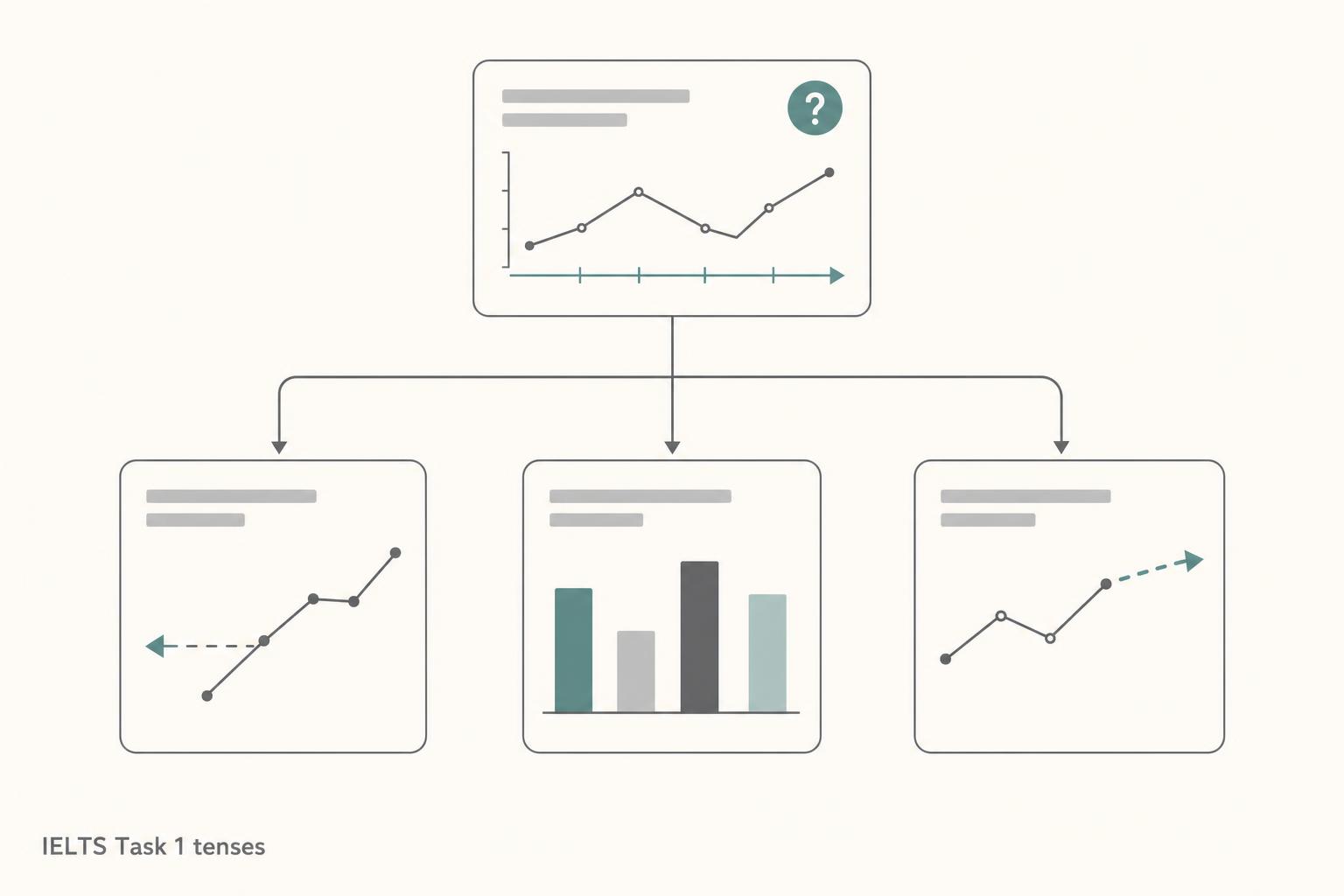
The question at the top of the tree is about the chart, not about your grammar. Everything below it follows.
Work through it in this order.
1. Does the visual carry dates — years, months, periods?
2. No dates at all? Present simple. A chart comparing four countries, or one showing a typical household's spending, has no time reference to report, so there is nothing to put in the past.
3. Is it a process diagram? Present simple, largely passive, for a manufactured process: the pulp is fed into. Natural cycles take present simple active: water evaporates.
4. Is it a map? Past forms for change already carried out, future or modal forms for change only proposed.
One thing sits outside the tree. Sentences about the document itself — the chart shows, the graph compares, the diagram illustrates — stay in present simple whatever the dates say. The chart exists now, in front of you, whichever decade it reports.
1. A dated line or bar graph, every period in the past. Past simple carries the reporting; past perfect earns its place only where sequence matters.
Car ownership in the three cities rose steadily between 1990 and 2010, with Riverton climbing from 180 to 410 vehicles per thousand residents.
By 2005, Eastport had already passed the figure Riverton reached five years later.
A full dated bar chart written up and scored line by line sits in IELTS Task 1 Academic band 7 sample: bar chart, scored line by line, if you want to see the tense held across a whole answer rather than in isolated sentences.
2. A comparison with no dates on it. Present simple, and no apology for it. Writers who have absorbed "Task 1 is past tense" often force a past here and produce sentences that claim something happened when the chart never said so.
Households in the highest income group spend roughly twice as much on transport as those in the lowest.
Housing accounts for the largest share of spending in all four groups.
3. A chart with projected years on it. The projected part takes future forms, and it is worth naming the projection so the reader knows you noticed.
Demand is projected to reach 340 units by 2035, an increase of just over a fifth on the last recorded year.
Figures from 2030 onward are estimates rather than recorded values.
4. A graph that holds both at once. The backbone tense changes partway through the paragraph, at the chart's own boundary between recorded and projected data. This is the case that produces the most errors, so it gets its own section below.
5. A process diagram. Present simple, and passive wherever the agent is a machine or an unnamed operator. Sequencing words do the ordering; the tense stays flat throughout.
The harvested cane is washed and then fed into a set of rollers, where the juice is extracted.
Once the syrup has cooled, it is poured into moulds and left to crystallise.
6. A map, or two maps of the same place. Split it by whether the change has happened. Completed change takes past simple or past passive; proposed change takes future or modal forms.
The woodland to the north of the village was cleared and replaced by a housing estate.
A pedestrian bridge is due to be built across the river at the eastern end of the site.
A note on the last two. Passive voice is not a scoring device in itself, and a script stuffed with passives to look formal usually reads worse, not better. In a process diagram the passive is simply accurate: nobody is named, so no subject can be. Use it where it is true and drop it where it is not.
Across all six, the same test applies to any sentence you are unsure of. Ask what the chart claims about time, then ask whether your verb makes the same claim. If the chart shows a figure recorded in 2018 and your sentence says rises, the two disagree, and the disagreement is yours to fix.
The rule that solves this case: set each verb by where its data point sits relative to the chart's boundary between recorded and projected values, not relative to today's date. A graph published with data to 2024 and projections to 2040 has its boundary at 2024, and it keeps that boundary no matter when you sit the exam.
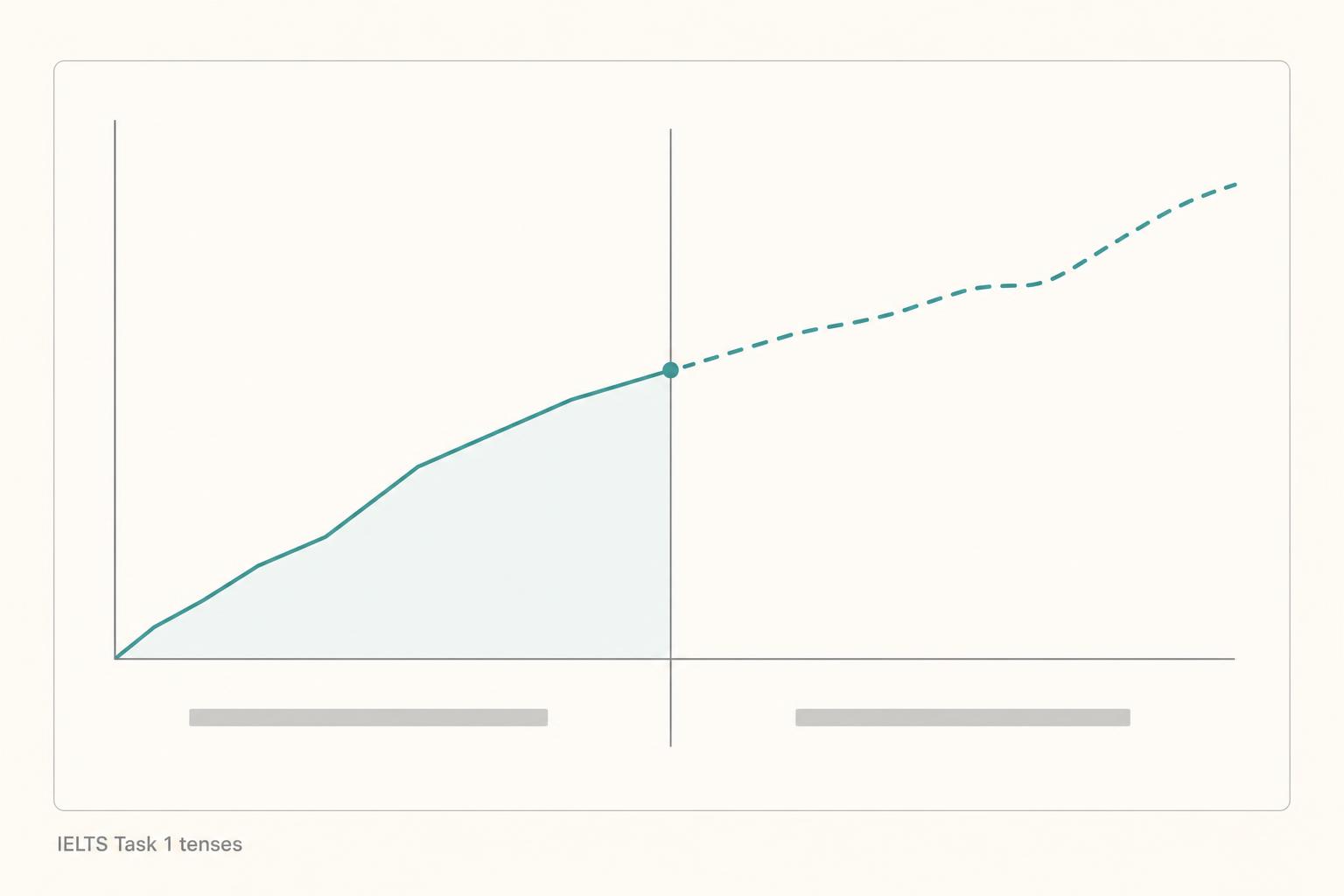
The boundary belongs to the chart, not to the calendar. Your verbs change where the line stops being solid.
Handled well, the switch is invisible:
Between 2010 and 2024, energy demand in the region grew by around 40 per cent, with the sharpest rise after 2018. From 2025 the trend is projected to flatten, and demand is expected to settle at just under 500 terawatt-hours by 2040.
Handled badly, it does two kinds of damage:
Between 2010 and 2024, energy demand grows by around 40 per cent. From 2025 the trend flattened and demand settled at just under 500 terawatt-hours by 2040.
The first verb is a straightforward accuracy error, and accuracy errors live in Grammatical Range and Accuracy. The second half is worse than a grammar slip: settled tells the reader that a forecast has already happened. The data has been misreported, and misreported data reaches Task Achievement, because that criterion asks you to report what the visual actually says. That is the boundary between the two criteria, and it is narrower than most guides admit — a tense error is a GRA problem right up to the point where it changes the meaning of the figure, and then it is both.
One more move helps Coherence and Cohesion at the same time: mark the switch in words as well as in verbs. A short clause — figures after 2024 are projections — tells the reader a boundary has been crossed, so the change of tense reads as deliberate rather than careless.
Here is what the public band descriptors say about Grammatical Range and Accuracy for Task 1.
Read band 7 closely. The phrase carrying the weight is generally well controlled — a judgement about the whole script, not a tally of individual verbs. A report that picks past simple on line one and holds it to the end reads as controlled even where the choice is arguable. A report that alternates between rose and rises inside a single paragraph does not, because the same error surfaces again and again, and repetition is what stops control looking general.
That gives an unintuitive but useful conclusion: a defensible-but-debatable tense held consistently costs you less than the correct tense applied half the time. It also explains why the fix is usually structural rather than grammatical. Most candidates who mix tenses in Task 1 know the forms perfectly well; they lose the thread while concentrating on the data, and the verb follows whatever the last sentence did.
The practical check takes thirty seconds at the end. Read only your verbs, in order, skipping everything else. Any point where the timeline jumps without the chart jumping is your error list, and it is nearly always shorter than it feels.
Two limits worth stating plainly. Tense is a GRA matter, not a Task Achievement one, unless it changes what the data says. And nothing in the public descriptors describes how examiners read or what they count, so treat any advice built on that as guesswork.
Can I write will for projected figures?
Yes. The descriptors name no individual words, and there is no basis for the claim that will is penalised in Task 1. Varying it with is projected to or is expected to helps Lexical Resource; avoiding will out of fear helps nothing.
Should I use the present perfect?
Only where a genuine link to the present exists — has remained stable since 2015, on a chart running to today. Graphs with closed date ranges rarely need it, and forcing it in creates exactly the timeline slips this article is about.
Does the wrong tense cost Task Achievement marks?
Not by itself. It reaches Task Achievement only when the tense misstates the data — calling a forecast a recorded fact, or the reverse.
Do I need past perfect to reach band 7?
No. Band 7 GRA asks for "a variety of complex structures" used "with some flexibility and accuracy". A past perfect used where the sequence calls for one contributes; a past perfect bolted on for effect usually costs accuracy instead. Which structures count as range, band by band, is set out in IELTS Writing band descriptors explained.
Where does tense fit in the overview?
The overview describes the visual, so the chart shows stays present simple; any trend named inside it follows the same rules as the body.
Descriptor wording is quoted from the public IELTS Writing band descriptors (updated May 2023). The four Task 1 criteria are named in the IELTS writing key assessment criteria guide.
Bandly grades your essay or letter against all four criteria and shows the gap to your target band, sentence by sentence.
A band 5.5 essay scored 5/6/5/6, plus the exact sentence holding each criterion down and the minimum fix that clears the band 6 line.
The same IELTS Task 2 essay at band 6 and band 7, with every edit tagged to the criterion it moved — and the averaging trap that keeps you at 6.5.