Sample essays
Band 5.5 IELTS essay: the 4 mistakes that capped the score
A band 5.5 essay scored 5/6/5/6, plus the exact sentence holding each criterion down and the minimum fix that clears the band 6 line.
10 min read
Band 6 penalises overuse of linking words. See what band 7 cohesion needs instead — reference and substitution — in one paragraph scored three ways.
There is no list of linking words that moves IELTS Writing from band 6 to band 7, and hunting for one is usually what keeps a script at 6. The public Band Descriptors say the opposite of what most advice pages say: at band 6, cohesive devices are penalised for overuse, not rewarded for quantity, and the word band 7 actually introduces is not a connector at all — it is reference and substitution.
That single difference explains a lot of scripts that look organised and still score 6 for Coherence and Cohesion. The writer has done what they were told: one connector per sentence, a signpost at the top of every paragraph, a Firstly / Secondly / Finally spine holding the essay together. The examiner reads it and sees machinery, not progression.
Two things before we go further. Coherence and Cohesion is one of four criteria — Task Response, Coherence and Cohesion, Lexical Resource, and Grammatical Range and Accuracy — and your Writing band comes from all four weighted equally, so nothing in this article can move your band on its own. And everything below is judged against the wording in the public IELTS Writing Task 2 Band Descriptors (Updated May 2023), quoted rather than paraphrased, because the paraphrases are where the bad advice comes from.
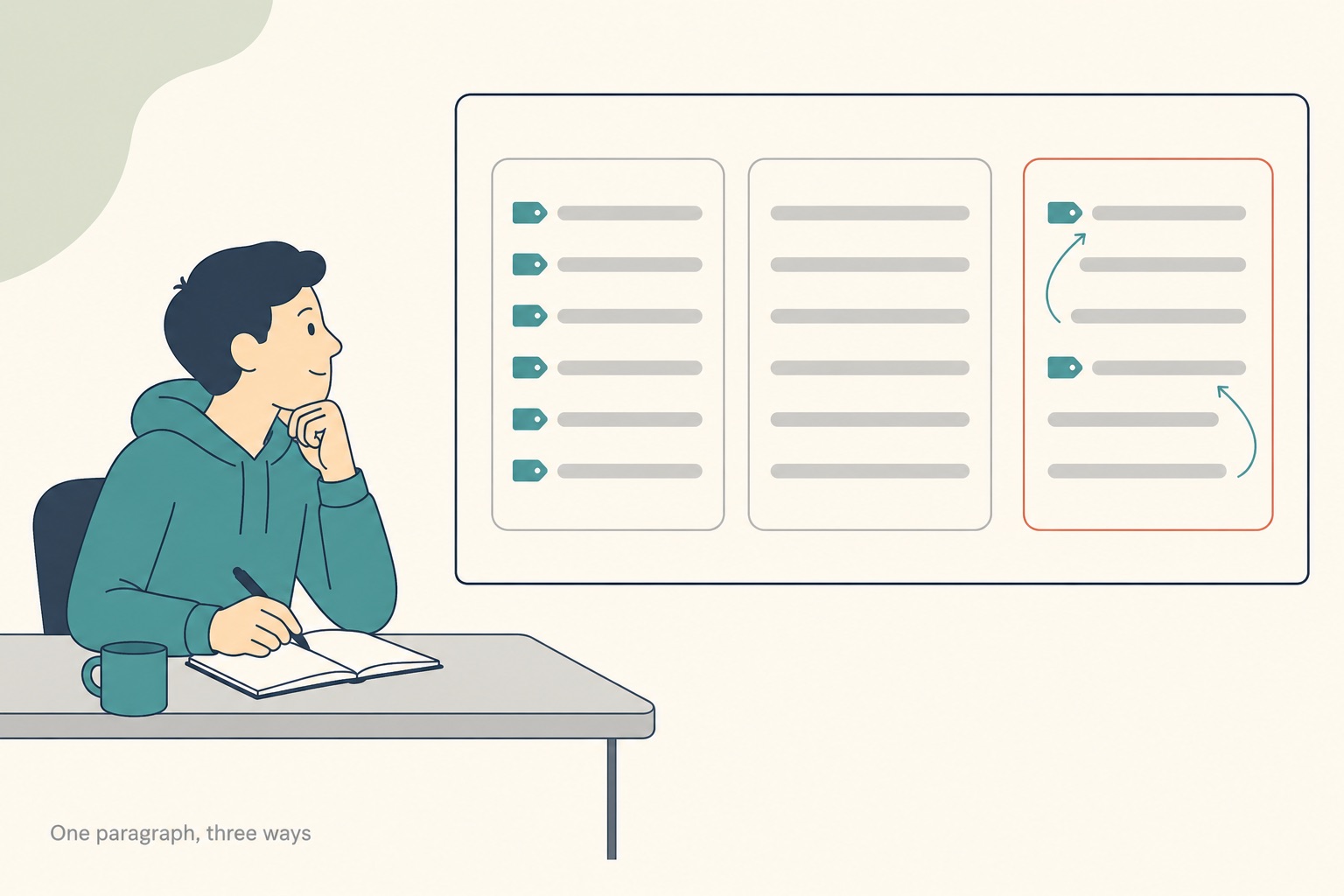
One paragraph, three ways. Only the third is doing cohesion that would break if you removed it.
Here is the band 6 Coherence and Cohesion descriptor in full:
"Information and ideas are generally arranged coherently and there is a clear overall progression. Cohesive devices are used to some good effect but cohesion within and/or between sentences may be faulty or mechanical due to misuse, overuse or omission."
Read the second sentence again. Three failure modes sit side by side, and they are treated as equivalent: misuse, overuse, omission. Most candidates have been trained to fear exactly one of them. They fix omission by adding connectors, and they walk straight into overuse — the same band, from the opposite direction.
Then read the word mechanical. It is not a comment about how many devices you used. It is a comment about whether the cohesion in your writing is doing any work. A connector that could be deleted without changing the relationship between two sentences is mechanical by definition: it announces a relationship the sentences already have, or a relationship they do not have at all.
This is why "use eight to ten linkers" is bad advice with a descriptor quotation sitting directly against it. The band 6 line does not set a floor you can climb by adding more. It describes a ceiling that adding more will not lift.
One body paragraph, one argument, written three ways. The prompt and the paragraphs are written for this article — they are not from a past paper. I am judging Coherence and Cohesion only here; a single paragraph cannot produce a band for a whole script, and it says nothing about Task Response, Lexical Resource or Grammatical Range and Accuracy.
The prompt: Some employers now allow staff to work from home for part of the week. Do the advantages of this outweigh the disadvantages?
Version A — the connector-heavy version
Firstly, home working saves employees a great deal of time. Moreover, the average commute in large cities consumes over an hour each day. Furthermore, this time can be redirected towards rest or family. In addition, employees who sleep longer perform better at work. Therefore, employers also benefit from the arrangement. Consequently, the practice has spread rapidly. Finally, both sides gain from it.
Seven sentences, seven connectors. The problem is not that the words are forbidden — no word in that paragraph is a penalised word, and no such list exists. The problem is that at least three of the connectors misdescribe the relationship they mark. Moreover introduces the evidence for the previous claim, not an additional claim. In addition introduces a causal step. Consequently is doing the work of a summary. That is the descriptor's misuse and overuse together, in one paragraph: cohesion that is "faulty or mechanical". This paragraph sits at band 6 for CC and would not rise above it if I added three more devices.
Version B — the stripped version
Home working saves employees a great deal of time. The average commute in large cities consumes over an hour each day. This time can be redirected towards rest or family. Employees who sleep longer perform better at work. Employers benefit from the arrangement. The practice has spread rapidly.
Delete every connector and something interesting happens: the paragraph is no worse. The relationships were always carried by the content. But the reader now has to reconstruct the logic without help, and one link — between longer sleep and the employer's benefit — is genuinely lost. This is the third failure mode in the same descriptor line, omission, and it lands in the same place: band 6 for CC.
Version C — reference and substitution
Home working saves employees a great deal of time. In large cities the daily commute consumes over an hour, and that hour is returned to rest or to family. Employees who use it to sleep longer are measurably sharper the following day, which is why the arrangement is not simply a concession to staff: employers recover the same hour as attention. This is the reason the practice has spread so quickly among firms that once resisted it.
Count the connectors: two, and neither is a paragraph-opening signpost. What is holding this together instead is that hour, it, the same hour, which, This — pointing backwards at things already named, and replacing them rather than repeating them. That is what the band 7 line means by "including reference and substitution", and it is why this version reads as progression rather than as a list. CC here is band 7: the ideas are logically organised, the devices are flexible, and the cohesion is doing work that would break if you removed it.
The band 7 Coherence and Cohesion descriptor reads:
"Information and ideas are logically organised, and there is a clear progression throughout the response. A range of cohesive devices including reference and substitution is used flexibly but with some inaccuracies or some over/under use."
Two things are worth pulling out. First, band 7 still tolerates "some inaccuracies or some over/under use" — you do not need a clean sheet. Second, the phrase band 6 does not contain: including reference and substitution. Most preparation material treats cohesive devices as a synonym for connectors. The descriptor does not.
Reference is pointing back at something already in the text instead of naming it again: pronouns (it, they, this, those), determiners (such a policy, the latter), and comparatives that assume a previous term (a similar approach, the same hour). Every time you write this and it clearly attaches to one identifiable thing in the previous sentence, you have produced cohesion an examiner can see and no list would have given you.
Substitution is replacing a repeated element with a shorter stand-in: Governments could fund the scheme directly, or private firms could do so instead. do so substitutes for the whole verb phrase. Some cities have already banned the practice; others are considering it. others substitutes for cities. In both cases the sentence stays short and the reader is carried forward.
There is a practical reason these two are worth more than connectors: they can only be used correctly if the ideas actually connect. You cannot write the same hour unless an hour was already established. A connector, by contrast, can be dropped on top of two unrelated sentences and will sit there — which is why the descriptor calls the result mechanical.
The failure mode of reference is worth naming too, because it is common at band 6: an unanchored this. If This shows that the policy is flawed could be pointing at any of the previous three sentences, the reference is faulty, and faulty cohesion is a band 6 feature regardless of how sophisticated the word is.

Read only the first four words of every paragraph. If they are a numbered spine, the cohesion is a template applied to the essay rather than a property of it.
Here is the quickest diagnostic I know. Read only the first four or five words of every paragraph and every sentence in your essay, ignoring the rest. If what you get is Firstly… Secondly… Moreover… In addition… Finally…, your cohesion is a template applied to the essay rather than a property of it. That is the "mechanical" in the band 6 line, and an examiner reaches it in seconds because it is visible before the content is read.
The signposted spine causes a second, quieter problem: it hides weak progression instead of creating it. Secondly asserts that a new point has arrived; it does not check whether that point follows from the previous one. Coherence in the descriptor is about progression, not enumeration — and enumeration is very good at concealing its absence.
The fix is not deletion for its own sake. Take the essay you have and mark, for each paragraph opener, what relationship the previous paragraph has to this one: contrast, cause, concession, or a genuinely new parallel point. Where the honest answer is "cause", write the causal link into the sentence — because that hour is recovered, employers… — instead of stamping Therefore on the front. Where the honest answer is "a new parallel point", Secondly is fine, because it is true. That is the only test.
One consequence: a band 7 script often contains fewer visible connectors than a band 6 script and reads as better organised. If you have been counting linkers as a proxy for cohesion, this looks like a paradox. It is only a paradox from inside the counting.
Should I stop using Firstly, Moreover and Furthermore entirely?
No. There is no list of penalised words, and any advice naming specific words as automatic deductions is inventing a rule. Use them where the relationship they claim is the relationship that exists.
How many cohesive devices should a band 7 essay have?
The descriptors give no number, and neither will I. The band 7 line asks for a range used flexibly, which is a description of variety and fit, not of frequency.
Does this apply to Task 1 as well?
Coherence and Cohesion is assessed in both tasks, and the behaviour described here — connectors stamped on top of sentences that already relate, or that do not — is just as visible in a data description as in an essay. The wording quoted above is from the Task 2 descriptors; check the Task 1 sheet for the exact Task 1 phrasing before quoting it.
Do examiners count linking words?
Nothing in the published assessment criteria describes counting, and there is no public source for the claim. What the descriptor describes is a judgement about whether cohesion is accurate, flexible and non-mechanical.
My essay has almost no linking words. Is that safer?
No — omission is named in the band 6 line alongside overuse. The target is not fewer devices; it is cohesion that carries meaning, which is what reference and substitution do.
The public band descriptors are on ielts.org.
Bandly grades your essay or letter against all four criteria and shows the gap to your target band, sentence by sentence.
A band 5.5 essay scored 5/6/5/6, plus the exact sentence holding each criterion down and the minimum fix that clears the band 6 line.
The same IELTS Task 2 essay at band 6 and band 7, with every edit tagged to the criterion it moved — and the averaging trap that keeps you at 6.5.