Criteria
How to get IELTS writing feedback when you don't have a teacher
No teacher? Four ways to get IELTS writing feedback, what each one misses, and how to tell useful feedback from comments that won't move your band.
10 min read
Not always your lowest one. Why the cheapest criterion to move comes first, how the averaging decides it, and the order that usually works.
Fix the criterion you can move up a whole band with the least work — which is usually not the one with the lowest score. For most candidates that means Task Response first, then Coherence and Cohesion, and only then the two language criteria, because the first two change when you change a decision and the last two change only as your English does.
That runs against the instinct most people have after a disappointing Writing band, which is to find the weakest area and pour everything into it. The instinct is not wrong so much as incomplete. This article sets out why the averaging behind your band makes the cost of each improvement matter as much as the size of the gap, what each of the four criteria takes to move, the order that follows from that, and the one thing you need before any of it is useful.
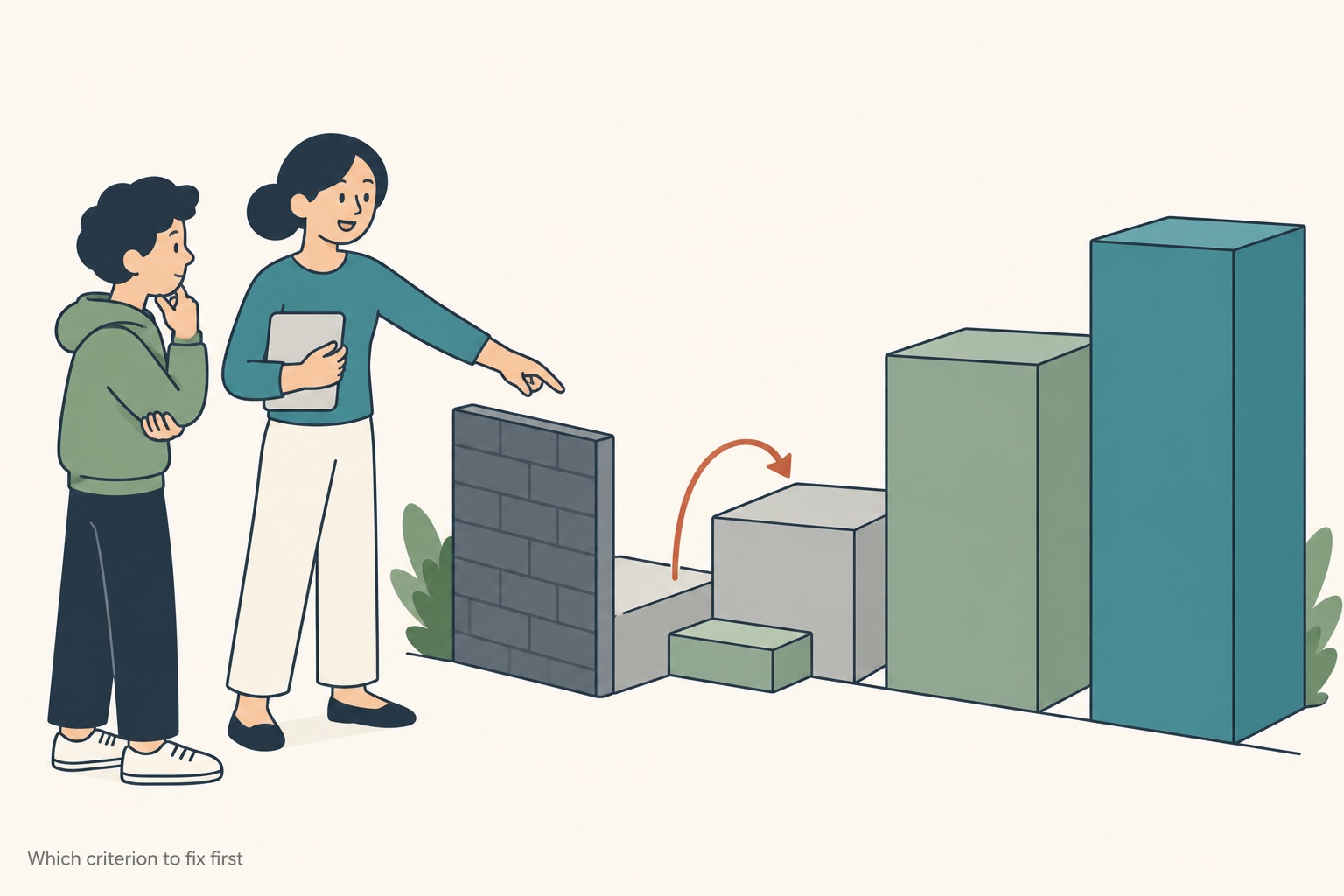
The lowest block is not always the one to climb first.
Every essay you write for IELTS is marked on four criteria: Task Response (Task Achievement in Task 1), Coherence and Cohesion, Lexical Resource, and Grammatical Range and Accuracy. They are weighted equally. That single fact reframes the question. If a band gained on grammar is worth exactly the same to your score as a band gained on Task Response, then the useful question is not "which is worst?" but "which will move soonest?"
Sometimes those have the same answer. Often they do not. A candidate with Task Response 6 and Lexical Resource 6 has two criteria at the same level, and one of them can move on the next essay while the other will take sustained reading and writing to shift. Spending the next month on vocabulary first is not wrong — it is just the slow route to the same quarter of a band.
So the rule has two parts. Find your lowest criterion or criteria. Then, among the ones that are holding you down, start with the one that is cheapest to move. The rest of this article is about how to tell which that is.
Each task is scored as the average of its four criterion bands, and the criterion bands are whole numbers. That means a single criterion rising by one band moves the task score by a quarter.
Work it through on a typical Task 2 profile:
Two things follow. The first is that half a band on a task usually needs two criteria to move, not one. A single improvement leaves you on a quarter — and how a quarter resolves to a reported band is not something IELTS publishes, so it is not something to plan around. If you want the half band with certainty, you are looking for two moves.
The second is that the two moves do not have to be on the weakest criterion. In the profile above, Task Response and Coherence are both at 6, both need to move, and it makes no difference to the arithmetic which you do first. It makes a large difference to how soon you see it.
Then there is the weighting between tasks. Your Writing band combines the two task scores with Task 2 counting twice: (Task 1 + Task 2 × 2) ÷ 3. A criterion that is weak in Task 2 is worth twice as much to fix as the same criterion in Task 1. The full arithmetic, and where the public rules stop, is set out in how your IELTS writing band is really calculated.
The four criteria do not improve at the same rate, and the reason is structural rather than a matter of effort. Two of them largely measure decisions you make while writing. The other two measure a body of language you have built up over time.
Task Response — mostly decisions. The features that hold essays at band 6 on Task Response are things like a part of the question left unanswered, a position that shifts between the introduction and the conclusion, and main ideas that are listed rather than developed. Each of those is a choice. On the next essay you can decide to split the question into its parts before you write, keep one position throughout, and explain why each idea holds instead of restating it. None of that requires English you do not already have. This is why a band 6 on Task Response is so often the cheapest band in the whole script.
Coherence and Cohesion — mostly decisions, with some skill. Paragraphing, the order of ideas and a clear central topic in each paragraph are planning decisions, and planning can change straight away. Cohesive devices are partly a skill: a candidate who relies on a handful of connectors at the start of every sentence has to learn to link ideas through reference and sentence structure instead, which takes practice — the linking words that actually get band 7 covers that shift. So Coherence usually moves second — faster than the language criteria, slower than Task Response.
Grammatical Range and Accuracy — cumulative, but partly under control. Range means using a variety of complex structures, and that grows with practice. Accuracy is more controllable than it looks: a large share of the errors in timed essays are ones the writer could have caught, and a proofreading habit targeted at your own recurring errors starts working on the next essay. That habit will not turn a band 6 grammar profile into a band 7 on its own, but it is the part of this criterion that responds fastest.
Lexical Resource — the slowest. Band 7 vocabulary means using less common words with some awareness of style and collocation. There is no decision that produces that. It comes from reading and writing a lot, noticing how words are actually used together, and gradually using them yourself.
None of this comes with a timescale, and it would be dishonest to attach one. How long any criterion takes depends on where you start and how you practise.
Put the costs together with the arithmetic and a default order falls out: Task Response → Coherence and Cohesion → Grammatical Range and Accuracy → Lexical Resource.

One card goes first; the others wait their turn.
The reasoning is simple. Task Response is equally weighted with the others, it sits in Task 2 where every gain counts double, and it is the criterion most likely to move on the very next essay. Coherence follows for the same reasons in a weaker form. Grammatical accuracy comes next because a targeted proofreading habit pays off quickly even while range builds slowly. Lexical Resource is last in the order — not because it matters less, but because the work on it is long-term and should run alongside everything else rather than wait for it.
"Run alongside" is the important part. This order is about where your focused, essay-by-essay attention goes first. Reading widely and collecting vocabulary should never stop, whichever criterion you are working on.
There are three situations where the default order does not apply.
When one criterion is two bands behind. If your profile is Task Response 7, Coherence 7, Grammar 7, Lexical Resource 5, the weakest criterion is not a quarter-band problem. It is pulling the task down by half a band on its own, and the descriptors contain features at the lower bands — frequent errors that make reading hard, for example — that limit a script however strong the rest is. Fix that one first, whatever it is.
When your Task Response is already secure. If your essays reliably answer every part of the question with a clear, developed position, there is nothing cheap left on that criterion. Move straight to Coherence, and after that to the language.
When the weak criterion is only in Task 1. Task 1 counts for a third of the Writing band. A weakness that appears only there is worth fixing, but it is worth half as much as the same weakness in Task 2, so it should not jump the queue.
For what each criterion looks like at the next level up, how to get band 7 in IELTS Writing works through all four.
Everything above assumes you know your four criterion scores, and almost nobody does. The Test Report Form gives one Writing band and no breakdown, and a remark does not provide one either — can you see your IELTS score for each writing criterion? explains why.
Guessing is where the order goes wrong. Candidates tend to assume grammar is their weakest criterion because grammatical errors are the ones they can see. Task Response problems are much harder to spot in your own work, because you know what you meant each paragraph to say. That is the main reason a self-assessed band so often runs higher than the real one, and it is why so many people who are stuck at band 6.5 spend their time on the wrong criterion.
So before choosing an order, get a reading of your own essay against the band descriptors, one criterion at a time. Paste a Task 2 essay below — ideally one written under test conditions, on an unseen question, in 40 minutes — and you get an estimate for each of the four criteria separately, with the sentences each judgement is based on.
Read the result in two steps. First, find the lowest criterion or criteria: that is what is holding the task score down. Then apply the order above to decide which of them to work on first. If Task Response is among the lowest, start there. If the lowest is Lexical Resource and something cheaper is only one band higher, lift the cheaper one first while the vocabulary work carries on in the background. Write the next essay, re-mark it, and see what is lowest now.
These are estimates against the public descriptors — the same kind a teacher gives — not official bands. Only a certified examiner marking your test produces those. What the estimate gives you is the thing the order depends on: a name for the criterion you are actually fixing. The full descriptor wording for all four is in IELTS Writing band descriptors explained.
Which IELTS writing criterion should I fix first?
The one you can move up a whole band with the least work, which is not always the lowest one. For most candidates that means Task Response first, then Coherence and Cohesion, then Grammatical Range and Accuracy, then Lexical Resource — unless the lowest criterion is two bands behind the others, in which case it goes first whatever it is.
Is it better to fix my lowest criterion or my easiest one?
The criteria are weighted equally, so a band gained anywhere is worth the same to the task score. When the lowest criterion is also the cheapest to move — often Task Response — the two answers are the same. When the lowest is vocabulary or grammar, a cheaper criterion one band higher can usually be lifted first while the slower work continues.
How much does one criterion change my IELTS writing band?
Each task is the average of four whole-number criterion bands, so one criterion rising by a band moves that task's average by a quarter. Whether a quarter changes your reported band depends on where the other three sit, and Task 2 counts twice as much as Task 1 in the overall Writing band.
Why is Task Response the quickest criterion to improve?
Because most Task Response problems come from decisions rather than from skill: answering every part of the question, keeping one clear position, and developing each main idea instead of listing it. Those are choices you can change on the next essay. Vocabulary and grammatical range build up through practice and do not change because you decide they should.
How do I know which criterion is my lowest?
Your Test Report Form does not show it — it gives one Writing band. You have to mark a piece of your writing against the public band descriptors one criterion at a time, or have someone else do it.
The description of the four Writing criteria and how they are averaged is from the IELTS scoring in detail page. Descriptor features are paraphrased from the public Writing band descriptors published by IELTS.
Bandly grades your essay or letter against all four criteria and shows the gap to your target band, sentence by sentence.
No teacher? Four ways to get IELTS writing feedback, what each one misses, and how to tell useful feedback from comments that won't move your band.
A remark only moves a script that sat on a band boundary. How to count your eight criterion marks and work out whether yours did, before you apply.