Criteria
Does ChatGPT overrate your IELTS writing? A criterion-by-criterion check
ChatGPT often scores IELTS essays higher than an examiner. Why it happens, which criterion the gap opens on, and three prompts that work better.
11 min read
Two Task 2 essays, same prompt, almost the same length — one band 7, one band 8. Every difference traced to a line in the official band descriptors.
A band 8 IELTS essay example is not a longer or harder version of a band 7 answer — it is the same task done with fewer loose ends. The two essays below respond to the same Task 2 prompt at almost the same length, and the band 8 one is in fact eight words shorter, which means none of the difference between them can be explained by volume.
Every point of separation traces back to a specific line in the public band descriptors. All wording quoted here is from the current version, updated May 2023; pages still quoting the earlier one are describing a scale that no longer exists.
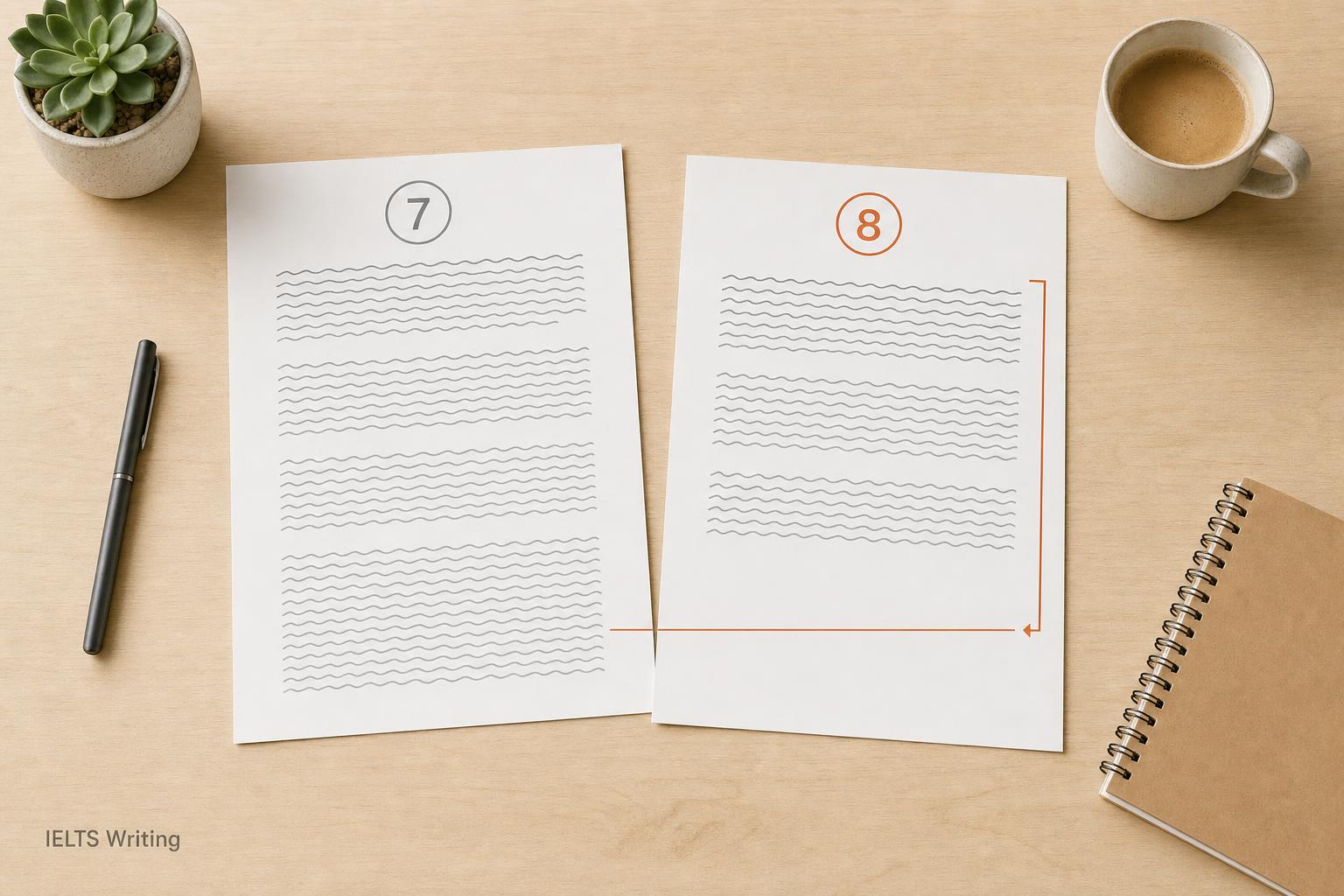
The band 8 answer is eight words shorter than the band 7 answer. Whatever the difference is, it is not volume.
Prompt (written for this article): Some people believe that governments should invest in public transport rather than in building new roads. To what extent do you agree or disagree?
Both answers were written for this article; neither is a real exam script.
Traffic congestion is a serious problem in many cities today. It is argued by some people that money should be spent on public transport instead of new roads. I agree with this view, although new roads are sometimes necessary.
The main reason I support investment in public transport is capacity. A bus lane or a train line can move far more people than a road lane of the same width, so the space is used more efficiently. In cities like Seoul, the subway carries millions of passengers every day, and without it the roads would be completely blocked. Building more roads, on the other hand, often attracts more cars. This is a well-known effect, and it means the congestion returns after a few years.
Secondly, public transport is better for the environment. Cars produce a lot of emissions per passenger, while a full train produces much less. Governments that want to reduce air pollution should therefore make trains and buses more attractive than driving. Also, public transport is cheaper for ordinary families who cannot afford a car.
However, I would not say that road building should stop completely. Some regions, especially rural areas, do not have enough population for a railway. In these places a good road is the only realistic option, and it also allows goods to be transported. Emergency vehicles need good roads too, and not every journey can be made by bus.
In conclusion, I believe governments should give priority to public transport in cities because it moves more people and creates less pollution, but roads should still be maintained and built in areas where the population is too small for any other option.
Where a city is already dense, public transport delivers far more movement per unit of space and money than new road capacity, so I largely agree with this position, with the qualification that the argument weakens outside cities.
The case rests on geometry before it rests on environmentalism. A single lane of urban road moves a limited number of people an hour when they travel by car; the same width given to a segregated bus corridor or a metro line moves several times that number. Road building does not solve this, because added capacity lowers the effective cost of driving and draws in trips that were previously suppressed. Within a few years the queue re-forms, and the city has spent its budget buying the same delay at a larger scale.
The environmental gain follows from that fact rather than standing beside it. Emissions fall not because trains are inherently clean, but because each passenger occupies a fraction of the energy that a private car requires. A policy that shifts even a modest share of commuters away from driving therefore cuts pollution without demanding sacrifice from them, provided the alternative is frequent and reliable enough to be chosen freely.
Outside dense areas that logic collapses. Where settlements are scattered, no timetable can serve them at a cost the public accepts, and roads remain the only infrastructure that carries freight, farm traffic and ambulances alike.
The honest conclusion is not that roads are wasteful, but that they are the wrong instrument in the one place where congestion actually bites: the dense city, where space rather than asphalt is the binding constraint.
The four sections below take one criterion each: the band 7 wording, the band 8 wording, and the two sentences where the difference lands.
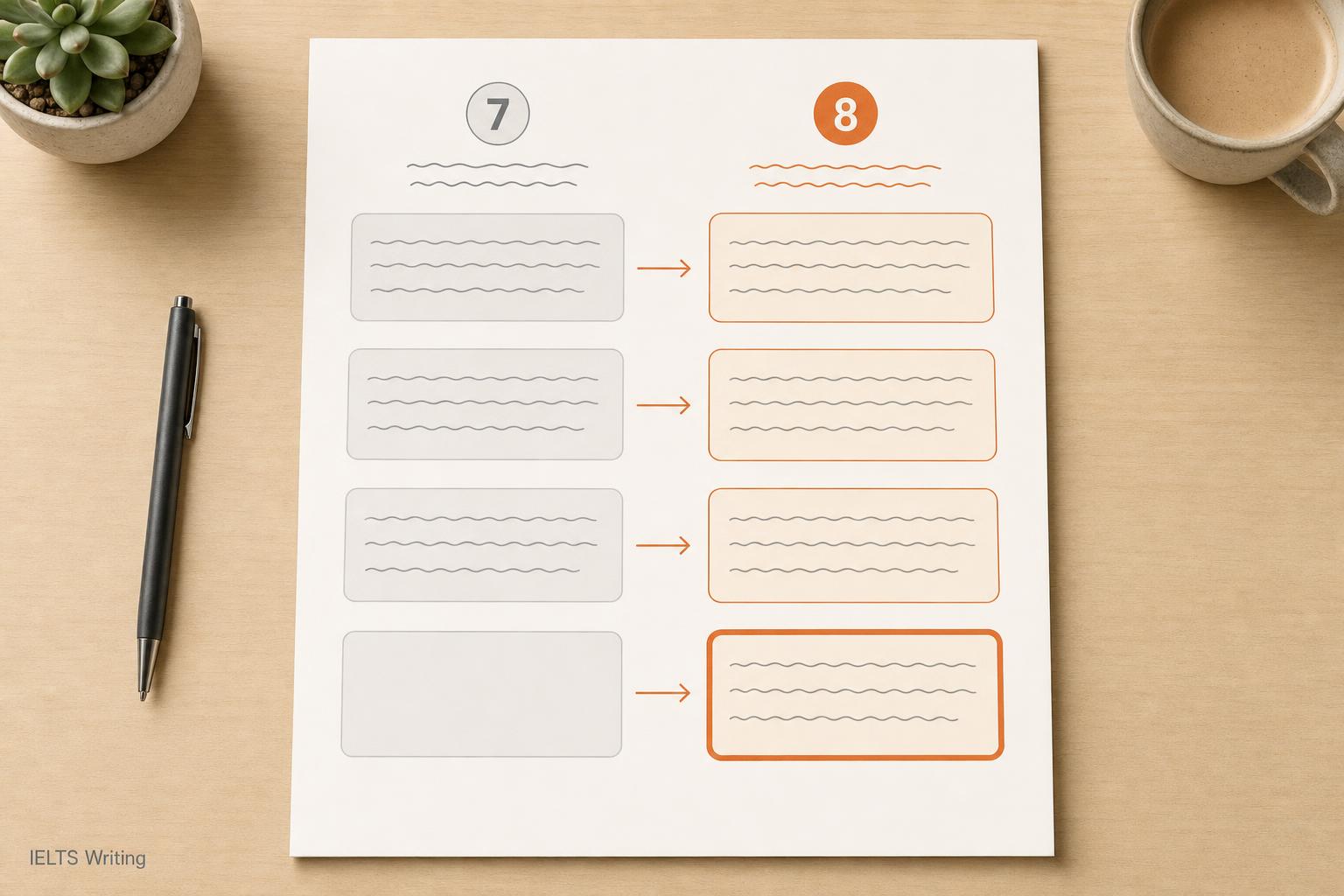
Three criteria change wording between 7 and 8. The fourth adds a line that band 7 does not contain at all.
Band 7 reads: "The main parts of the prompt are appropriately addressed. A clear and developed position is presented. Main ideas are extended and supported." Band 8 reads: "The prompt is appropriately and sufficiently addressed. A clear and well-developed position is presented in response to the question/s."
Two words carry the change: sufficiently, and *well-*developed. Band 7 asks whether the prompt was addressed; band 8 asks whether it was addressed enough.
In the band 7 answer, look at: "Also, public transport is cheaper for ordinary families who cannot afford a car." The idea is relevant and supported by nothing: it arrives, it is asserted, and the paragraph ends. That is the gap between extended and developed — the writer added a point where the task needed the existing one taken further.
Compare the band 8 answer: "Road building does not solve this, because added capacity lowers the effective cost of driving and draws in trips that were previously suppressed." The following sentence then carries that mechanism to its consequence rather than moving to a new one. Same prompt, same paragraph budget, one idea instead of two — and the position is still standing at the end of the essay.
This is the same fault line one band lower. In band 6.5 vs band 7, the half band also came from Task Response and Coherence and Cohesion rather than from vocabulary, which is worth knowing before you spend another month on word lists.
Band 7 reads: "Information and ideas are logically organised, and there is a clear progression throughout the response." Band 8 reads: "The message can be followed with ease. Information and ideas are logically sequenced, and cohesion is well managed."
Organised means the reader can see where the parts begin and end. Sequenced means each part is in the only position it could occupy.
The band 7 answer opens its third paragraph with "Secondly, public transport is better for the environment." Nothing is wrong with it, and the label does real work — but the label is doing the work. Remove the word secondly and the paragraph has no stated relationship to the one before it.
The band 8 answer opens the equivalent paragraph with "The environmental gain follows from that fact rather than standing beside it." The connection is made by referring back to the previous argument, not by numbering it, and it tells the reader what kind of connection it is. That is what "cohesion is well managed" means in practice: the joins are carried by reference, and the essay would hold together with the connectives stripped out.
Band 7 reads: "The resource is sufficient to allow some flexibility and precision. There is some ability to use less common and/or idiomatic items." Band 8 reads: "A wide resource is fluently and flexibly used to convey precise meanings."
The popular advice has these two backwards. Idiomatic language is named at band 7. It disappears at band 8, where the requirement becomes precise meaning. Reaching for idioms to sound advanced is, descriptor-wise, aiming lower.
The band 7 answer says: "Cars produce a lot of emissions per passenger, while a full train produces much less." Nothing here is wrong, and nothing is precise. A lot of and much less are placeholders where a measurement should be.
The band 8 answer says: "each passenger occupies a fraction of the energy that a private car requires." Every word there is ordinary — fraction, occupies, requires — and the meaning is exact. Band 8 vocabulary is usually plain vocabulary chosen well, which is why it rarely reads as showy.
Band 8 reads: "A wide range of structures is flexibly and accurately used. The majority of sentences are error-free." Band 7 has no equivalent error-free clause at all. It is the most concrete line in the scale, and worth repeating to yourself while you proofread.
The band 7 answer ends a paragraph with "Emergency vehicles need good roads too, and not every journey can be made by bus." Accurate, but two flat clauses joined by and, in a paragraph already built from short sentences — no range is demonstrated.
The band 8 answer covers the same ground in one sentence: "Where settlements are scattered, no timetable can serve them at a cost the public accepts, and roads remain the only infrastructure that carries freight, farm traffic and ambulances alike." A fronted subordinate clause, a relative clause, and coordination — three structures, one sentence, no errors. That is what flexibly and accurately is describing.
For how these four scales read from band 5 upwards rather than at this one join, see IELTS Writing band descriptors explained.
Strip both essays back and the band 8 answer wins on three sentences.
The opening: "Where a city is already dense… so I largely agree with this position, with the qualification that the argument weakens outside cities." The position and its limit arrive together, so the concession paragraph later is not a wobble — it was announced in line one.
The mechanism sentence: "Road building does not solve this, because added capacity lowers the effective cost of driving…" The band 7 answer had the same idea and wrote "This is a well-known effect." Naming an effect is not developing it. Explaining why it happens is.
The closing: "they are the wrong instrument in the one place where congestion actually bites." The band 7 essay concludes by restating both sides. The band 8 essay concludes by reasserting which side won and why, which is what a clear and well-developed position asks for.
Does a band 8 essay have to be longer than a band 7 essay?
No. The official requirement is "You must write at least 250 words", and IELTS states you "will be penalised if your answer is too short". There is no published upper figure or target range — and the band 8 essay above is the shorter of the two.
Do I need idiomatic language for band 8?
No — and this is the most common mistake at this level. Idiomatic items appear in the band 7 descriptor, not the band 8 one. Band 8 asks for precise meanings from a wide resource.
If one criterion is band 8, is the task band 8?
No. IELTS states that "The criteria are weighted equally and the score on the task is the average." A single band 8 criterion alongside three band 7s does not produce a band 8 for that task.
Can I reach band 8 writing in a plain style?
Yes. The descriptor asks for a wide range of structures used flexibly and accurately, and for the majority of sentences to be error-free. Neither requires ornament; plain and accurate outperforms ambitious and broken.
Descriptor wording is quoted from the public IELTS Writing band descriptors (updated May 2023). Task requirements and scoring are set out on ielts.org.
Bandly grades your essay or letter against all four criteria and shows the gap to your target band, sentence by sentence.
ChatGPT often scores IELTS essays higher than an examiner. Why it happens, which criterion the gap opens on, and three prompts that work better.
AI IELTS writing scores are not equally accurate across the four criteria. Where AI marking tracks an examiner, where it drifts, and how to use it.