Sample essays
Band 5.5 IELTS essay: the 4 mistakes that capped the score
A band 5.5 essay scored 5/6/5/6, plus the exact sentence holding each criterion down and the minimum fix that clears the band 6 line.
10 min read
A full IELTS General Training informal letter at band 7, scored against the official descriptors — and why writing it formally would have cost marks, not earned them.
A band 7 informal letter is not a formal letter with the vocabulary softened. This IELTS General Training informal letter band 7 sample is written to a friend, and the thing that keeps it at 7 rather than 6 is the same thing most candidates are coached out of doing: it actually sounds informal, from the greeting to the sign-off.
That is not a stylistic preference. The Band 7 General Training descriptor states that the response "presents a clear purpose" and that "the tone is consistent and appropriate to the task" — and for a letter to a friend, appropriate means informal. A stiff, buttoned-up letter to someone you have known for years is not a safe answer. It is a tone mismatch, and it is marked as one.

The register the task is asking for. Writing to a friend as though you were writing to a bank is a Task Achievement problem, not a safety net.
Below is the full letter, a criterion-by-criterion scorecard quoting the official Band 7 wording, and the three faults that keep it off a band 8.
Every General Training Task 1 prompt hands you a situation, three bullet points and a 150-word floor. The one below was written for this article — the task type is reproduced, the wording is ours, and nothing here comes from a past paper.
Task (written for this article): A friend who lives in another city is coming to stay with you next month. Write a letter to your friend. In your letter: say how you feel about the visit; describe what you have planned; explain what your friend should bring.
The answer runs to 166 words and is printed uncorrected. Mark it yourself before reading the scorecard if you want the practice.
Dear Ravi,
It's been ages since you were last here, and I couldn't believe it when your message came through — I read it twice on the bus and grinned like an idiot.
Anyway, I've already started planning. On the Saturday my brother is making a barbecue at his new place, so you'll finally meet everyone, and on the Sunday we could walk up to the old reservoir if the weather holds. Anyway, the rest of the week is yours, so you can sleep until noon and nobody will bother you.
One practical thing. My flat is freezing at night because the heating is ancient, so bring something warm to sleep in, and your walking boots for the reservoir. It would also be a great pleasure for me if you could bring a jar of your mother's chilli sauce, since the last one did not survive the month.
Let me know which train are you getting and I'll meet you at the station.
Take care,
Sam
Where the band comes from, before you read it: the letter is ours, and so is the marking, done against the public band descriptors. No examiner has seen it. "Band 7" on this page means band 7 on the published criteria.
Task 1 is marked on Task Achievement, Coherence and Cohesion, Lexical Resource, and Grammatical Range and Accuracy. Note the first one: Task Achievement, not Task Response — Task Response belongs to Task 2, and the two criteria are not interchangeable. It matters here, because the General Training wording of Task Achievement carries a requirement about tone that appears nowhere else in the marking scheme.
| Criterion | Official Band 7 wording | Evidence in this letter | Verdict |
|---|---|---|---|
| Task Achievement | "The response covers the requirements of the task… All bullet points are covered and clearly highlighted but could be more fully or more appropriately illustrated or extended. It presents a clear purpose. The tone is consistent and appropriate to the task. Any lapses are minimal." | Each bullet gets its own paragraph: the reaction to the news, the weekend plan, the packing list. The purpose is unmistakable by the second line. The register is informal throughout — except once. | 7. Covered and clear, thinly extended. "It would also be a great pleasure for me" is a lapse in tone, but a single one, which the band allows as "minimal". |
| Coherence and Cohesion | "Information and ideas are logically organised and there is a clear progression throughout the response. A range of cohesive devices including reference and substitution is used flexibly but with some inaccuracies or some over/under use." | Four paragraphs in the order a friend would expect: reaction, plan, practicalities, arrangements. Reference is clean — "it", "everyone", "the last one" all point somewhere unambiguous. | 7. The progression is clear, and the doubled "Anyway" is exactly the "over/under use" this band tolerates. |
| Lexical Resource | "The resource is sufficient to allow some flexibility and precision. There is some ability to use less common and/or idiomatic items. An awareness of style and collocation is evident, though inappropriacies occur." | "It's been ages", "grinned like an idiot", "if the weather holds" and "did not survive the month" are idiomatic and correctly pitched for a friend. "Making a barbecue" is not English. | 7. Idiomatic range is there; one collocation error is precisely the "inappropriacies occur" this band describes. |
| Grammatical Range and Accuracy | "A variety of complex structures is used with some flexibility and accuracy. Grammar and punctuation are generally well controlled, and error-free sentences are frequent. A few errors in grammar may persist, but these do not impede communication." | Conditionals ("if the weather holds"), a reason clause, a result clause with "so", and a present perfect opening. One embedded question is inverted: "which train are you getting" should be "which train you are getting". | 7. Error-free sentences are frequent and the one error changes nothing about the meaning — which is what the final sentence of this descriptor permits. |
Four sevens, so the letter scores 7.
Notice where each fault landed. Every one of them sits inside a phrase the descriptor itself writes into band 7: "any lapses are minimal", "some over/under use", "inappropriacies occur", "a few errors in grammar may persist". Band 7 is not a general impression of competence — it is that list. A letter containing none of those things is not a band 7 letter; it is a band 8 one.
This is also where the informal letter differs from its formal sibling: a formal complaint can reach band 7 with no grammatical error at all and be held back purely by range. Here, one live grammar error survives the marking, because the descriptor says it may.
Band 8 Task Achievement asks that all bullet points are "clearly presented, and appropriately illustrated or extended", with only "occasional omissions or lapses in content". Three things get in the way, and each is one rewritten sentence.
1. The tone breaks once. "It would also be a great pleasure for me if you could bring…" is the only sentence in the letter that sounds like a formal request to an institution. Everything around it sounds like a person talking to a friend. Band 7 permits minimal lapses, but a lapse is still a lapse, and this is the one an examiner would mark:
The request is not weakened. It is made warmer, which in a personal letter is stronger.
2. "Anyway" appears twice in one paragraph. The second one links nothing — it opens a sentence that changes topic in the opposite direction from the first. Linkers are not points to be collected; the Coherence and Cohesion descriptors name overuse as a fault at every band from 5 upwards. Cutting one is the whole fix:
3. "Making a barbecue" is not a collocation. A barbecue is something you have, hold or do; "make" belongs to the food, not the event. This is the clearest signal in the letter that the writer is reaching for idiomatic English they do not yet fully control — exactly what separates band 7 Lexical Resource from the "skilful use of uncommon and/or idiomatic items" band 8 asks for:
None of those three edits lengthens the letter. They move Task Achievement and Lexical Resource without touching the content, which is what makes them worth practising — the content was never the problem.
Academic Task 1 candidates describe a chart and never have to think about who is reading. General Training candidates do, and the descriptors put it in writing.
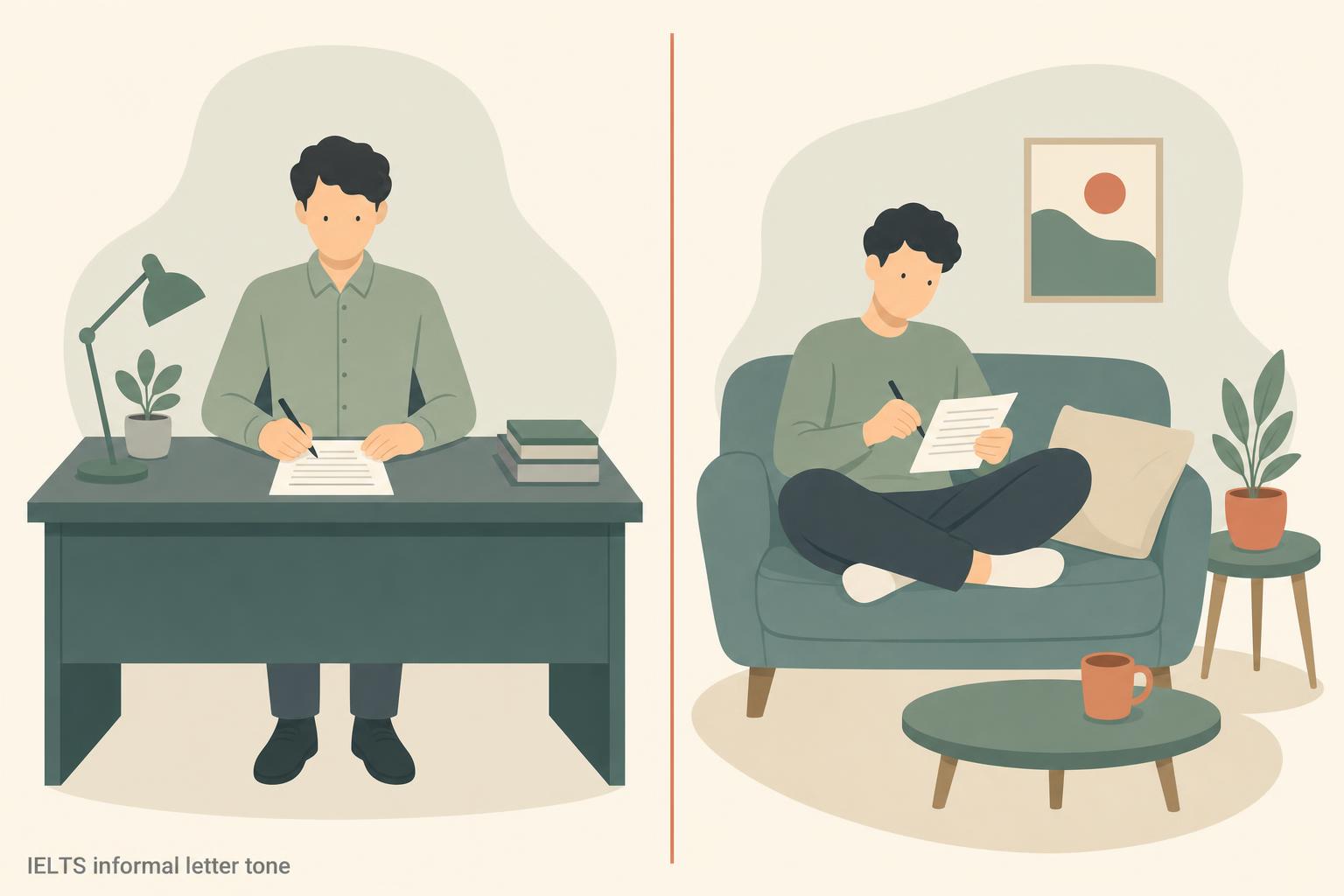
Two registers, one task. Only one of them is "appropriate to the task" when the reader is a friend.
Read the tone line down the bands and the direction is unmistakable. At band 7, "the tone is consistent and appropriate to the task." At band 6, "the purpose is generally clear. There may be minor inconsistencies in tone." At band 5, "the tone may be variable and sometimes inappropriate." Nowhere does the scale reward formality — it rewards a match between tone and reader, held all the way through.
That is why the common defensive strategy backfires. A candidate who has memorised "I am writing to inform you that…" and deploys it in a letter to a friend has not played it safe; they have written a letter whose tone does not fit the task, which is the band 6 description at best. IELTS states plainly that the letter may be personal, semi-formal or formal in style, and the prompt is what decides which.
There is a second failure mode in the opposite direction, and it is less common but more costly. Informal does not license non-standard English. Note form and bullet points are explicitly penalised, so the letter must be full connected prose. Abbreviations like "u" and "thx" read as spelling and word-formation errors, not as informal range. The target is spoken-sounding English written properly — contractions, phrasal verbs, idiom, short sentences where a friend would use one.
There is a quick check for your own draft, and it takes ten seconds. Read the letter aloud as though the person named at the top were sitting opposite you. Every sentence you would not actually say to their face — because it is too stiff, or too clipped, or sounds like a form letter — is a tone lapse, and you can hear them long before you can see them. For the wider picture of what each criterion is asking, the four criteria as conditions to meet is the companion piece to this one.
Can I use contractions in an informal letter?
Yes. Band 7 asks for a tone that is "consistent and appropriate to the task", and for a letter to a friend that means informal English, contractions included. "I have not" and "I would be grateful" to a close friend is a mismatch between tone and reader.
Is slang or text-speak allowed?
Informal is not the same as non-standard. Idiomatic language helps you — band 7 Lexical Resource rewards "some ability to use less common and/or idiomatic items". Abbreviations like "u", "thx" and "gr8" do not, because they read as errors rather than as range.
How do I know whether the letter should be informal?
The prompt tells you who you are writing to. IELTS says the letter may be personal, semi-formal or formal in style; a named friend or family member means personal, and an unnamed official does not.
Do I need to include addresses or a date?
No. The task asks for a letter of at least 150 words, not a reproduction of a posted envelope — the instructions never ask for either, and no descriptor mentions them. Note form and bullet points, however, are explicitly ruled out: write in paragraphs.
Where does the descriptor wording on this page come from?
From the public Writing Task 1 descriptors, updated May 2023 and published by ielts.org. The General Training sentences are marked "(General Training)" in the Task Achievement column, and they are the only place tone is mentioned.
Descriptor wording is quoted from the public IELTS Writing band descriptors (updated May 2023). Task requirements are set out on ielts.org.
Bandly grades your essay or letter against all four criteria and shows the gap to your target band, sentence by sentence.
A band 5.5 essay scored 5/6/5/6, plus the exact sentence holding each criterion down and the minimum fix that clears the band 6 line.
The same IELTS Task 2 essay at band 6 and band 7, with every edit tagged to the criterion it moved — and the averaging trap that keeps you at 6.5.