Criteria
Why your self-assessed IELTS writing band is higher than your real one
You marked your essay a 7 and got a 6.5. The gap is not vanity: you read what you meant, not what you wrote. Where it opens, criterion by criterion.
10 min read
Yes, but by a quarter per band, not a whole band. How four averaged criteria combine, the result that surprises people, and what to fix first.
Yes — one low criterion does lower your IELTS writing band, but by less than most people fear. Each task is the average of four equally weighted criterion bands, so a single criterion one band below the others moves that task's score down by a quarter, not by a whole band.
Candidates who know their grammar is weak often assume it caps the whole script — that an essay with grammar at 6 is "a band 6 essay" whatever else it does well. That is not how the marking works. This article works through the actual numbers, shows the one result in them that surprises people, and explains what the arithmetic says about where to put your effort next.
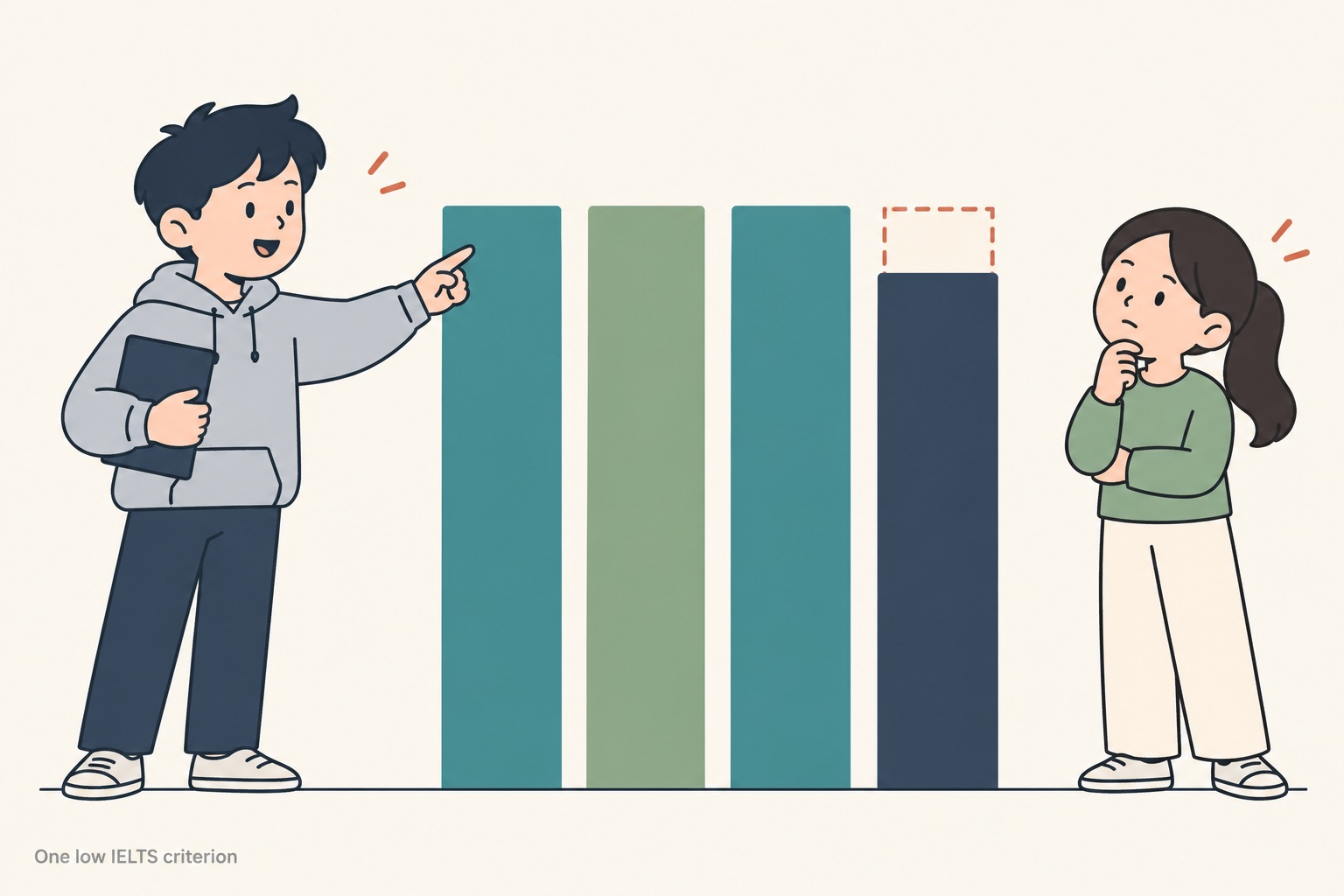
One criterion a band short costs a quarter, not a whole band.
IELTS marks each Writing task on four criteria: Task Response (Task Achievement in Task 1), Coherence and Cohesion, Lexical Resource, and Grammatical Range and Accuracy. IELTS describes the arithmetic in one line: the criteria are weighted equally and the score on the task is the average. Each criterion is awarded as a whole band, so the four of them add up to a total, and the total divided by four is the task score.
If three criteria are at 7 and the fourth is at 6, the total is 27 instead of 28, and 27 ÷ 4 is 6.75. The one weak criterion has cost exactly a quarter of a band on that task — no more. It has not dragged the task down to 6, and it has not been ignored either.
Two consequences follow straight away.
The first is that a single low criterion is never a ceiling. An essay can have one criterion at 6 and still sit much closer to 7 than to 6, because the other three are carrying it.
The second is that a single low criterion is never free. A script that is excellent on three counts and band 6 on the fourth is not a band 7 script. On a script near a boundary, that quarter can decide the band.
Then there is the second layer. Your overall Writing band combines the two task scores with Task 2 counting double — the usual working formula is (Task 1 + Task 2 × 2) ÷ 3. So a quarter lost on a Task 2 criterion weighs twice as much in that combination as the same quarter lost on Task 1. The full calculation, including where the published rules stop, is in how the IELTS writing band is calculated.
Every row below is simple addition and division, checked rather than estimated.
| Criterion bands (any order) | Total | Task average |
|---|---|---|
| 7, 7, 7, 7 | 28 | 7.0 |
| 7, 7, 7, 6 | 27 | 6.75 |
| 7, 7, 6, 6 | 26 | 6.5 |
| 7, 7, 7, 5 | 26 | 6.5 |
| 7, 6, 6, 6 | 25 | 6.25 |
| 7, 7, 7, 4 | 25 | 6.25 |
| 6, 6, 6, 6 | 24 | 6.0 |
Read down the table and a few things stand out.
Each band lost anywhere costs the same quarter. The criteria are weighted equally, so the average only sees the total, not where the missing band came from.
Some rows land on a quarter. A total of 27 or 25 gives an average ending in .75 or .25. Reported Writing bands are whole or half bands, so a quarter is intermediate arithmetic, not a result you will ever see on a report form. How IELTS resolves a quarter into a reported band is not published, and we are not going to guess at it here. What is certain is that 6.75 sits between 6.5 and 7.0 — and that moving one criterion changes the total either way.
Criteria are whole numbers, so the task score moves in steps. You cannot get "a little better" at Lexical Resource and see a small rise. A criterion either crosses into the next band or it does not, and when it does, the task average moves by a quarter. That is why improvements often feel invisible for a long time and then arrive all at once.
The quarter-band logic also works upwards. Three criteria at 8 and one at 6 make 30, an average of 7.5 — the same as two at 8 and two at 7. A strong script with one weak criterion is still a strong script.
Look again at two rows from the table:
Same total, same average. As far as the task score is concerned, one criterion that has dropped two bands is exactly equivalent to two criteria that have each dropped one.

The arithmetic says these profiles are the same. The fix says they are opposites.
The 7, 7, 6, 6 profile is a spread-thin script. Two criteria are each a band short. Typically that is something like Coherence and Cohesion at 6 because the paragraphs are organised but the linking is mechanical, and Grammatical Range and Accuracy at 6 because complex structures are attempted but errors are frequent. Getting back to 7.0 means two separate criteria each crossing a band boundary.
The 7, 7, 7, 5 profile is a script with one collapse. Three criteria are already at the target and one has fallen well short. A drop of two bands in one criterion while the others hold at 7 is rarely a general weakness in English. More often it is one specific, identifiable fault. On Task Response, band 5 describes an essay that addresses the task only partially — a part of the question left unanswered, a position that is hard to find, or ideas that drift away from what was asked, which is the pattern covered in off-topic IELTS essays. In Task 1, the band 5 descriptor describes detail recounted mechanically with no clear overview. Neither of those is a language problem. Both are decisions.
So the two profiles need different treatment. The spread-thin script needs two moderate fixes on two criteria. The collapsed script needs one fix on one criterion — but it has to be large enough to lift that criterion two bands, and the good news is that when the cause is a single decision, one change can do it. An essay that answers every part of the question instead of half of it does not climb one band at a time; the thing holding it at 5 is simply gone.
There is one important exception. If the collapsed criterion is Lexical Resource or grammatical range, the collapse is usually not a single decision. A vocabulary profile two bands below the rest often comes from memorised phrases that do not fit the context or language too limited for the topic, and that takes sustained work to change. The arithmetic is still the same 26 — but the cost of moving it is not.
Put the arithmetic and the causes together and a practical rule comes out: in most scripts, lifting the lowest criterion is the cheapest route to a higher band. There are three reasons.
The lowest band usually has the most visible cause. Descriptor features at band 5 are concrete and easy to point at — no overview, part of the question ignored, no clear paragraphing, errors that get in the way of meaning. Features at band 6 against band 7 are finer judgements about how consistently something is done. It is much easier to remove a missing overview than to make good linking slightly more flexible.
Every band gained counts the same. Because the criteria are weighted equally, a band gained on your weakest criterion is worth exactly as much to the task average as a band gained on your strongest one. There is no bonus for polishing what is already good.
Big gaps often close in one step. As the section above shows, a criterion two bands below the others is frequently held there by one fault. Fix the fault and the criterion can recover both bands at once — a half-band move on the task from a single change.
That rule has a limit, and it is the same one that runs through which IELTS writing criterion to fix first: cost matters as well as size. When the lowest criterion is one band below the others and it is Lexical Resource, a cheaper criterion at the same level or one band higher may move sooner, even though it is not the lowest. The lowest criterion is the default starting point, not an absolute rule.
And the rule only works if you know which criterion is lowest. That is the part most candidates get wrong. Your Test Report Form gives one Writing band, not four — can you see your IELTS score for each writing criterion? explains why no official route releases them. People fill that gap by guessing grammar, because grammar errors are the ones they can see, while Task Response problems hide in your own writing — part of why a self-assessed band runs higher than the real one.
Before any of the arithmetic above is useful, you need your own four numbers, which means marking a real essay against the public band descriptors one criterion at a time.
Paste a Task 2 essay below — ideally one written in 40 minutes on a question you had not seen before — and you get a separate estimate for each of the four criteria, with the sentences each judgement is based on.
Read the result in the order this article suggests:
These are estimates against the public descriptors, of the kind a teacher gives, not official bands; only a certified examiner marking your test produces those. What the estimate gives you is the one thing this whole calculation depends on: the name of the criterion that is actually holding your average down. The full wording for each criterion is in IELTS Writing band descriptors explained.
Does one low criterion lower my IELTS writing band?
Yes, but by less than most people expect. Each task is the average of four equally weighted criterion bands, so one criterion a band below the other three lowers that task's average by a quarter of a band. Two bands below lowers it by a half.
Can one weak criterion cap my IELTS writing band?
No. There is no ceiling rule in the averaging. An essay with three criteria at 7 and one at 6 averages 6.75, much closer to 7 than to 6. The weak criterion costs a quarter; it does not set the band.
Is one criterion two bands low the same as two criteria one band low?
For the task score, yes: 7, 7, 7, 5 and 7, 7, 6, 6 both total 26 and average 6.5. For the fix, no. A single criterion two bands down usually has one identifiable cause, while two criteria one band down need two separate pieces of work.
What happens if my four criteria average to 6.75?
Reported Writing bands are whole or half bands, so 6.75 is intermediate arithmetic. How IELTS resolves a quarter into a reported band is not published. Treat it as sitting between 6.5 and 7.0, and move a criterion so the total changes.
Should I fix my lowest criterion first?
Usually, because the lowest band tends to have the most visible cause and a band gained there counts the same as a band gained anywhere else. The exception is when the lowest criterion is vocabulary or grammatical range and a cheaper criterion is close behind it.
The statement that the four Writing criteria are weighted equally and averaged is from the IELTS scoring in detail page. Descriptor features are paraphrased from the public Writing band descriptors published by IELTS.
Bandly grades your essay or letter against all four criteria and shows the gap to your target band, sentence by sentence.
You marked your essay a 7 and got a 6.5. The gap is not vanity: you read what you meant, not what you wrote. Where it opens, criterion by criterion.
Three retakes, same band? The same flaw is being written into every script and nobody has pointed to it. The three that repeat, and how to break the loop.